The dynasty community came away from the 2026 rookie class feeling underwhelmed. Quarterback depth was scarce, the receiver class lacked depth and balance, and the running backs became uninspiring in a hurry after Jeremiyah Love and Jadarian Price, which created a massive appetite for the next wave of prospects.
Consider it delivered. The 2027 class is shaping up to be everything 2026 wasn’t: deep, exciting, and headlined by genuine dynasty franchise-altering talent at the most premium positions in SuperFlex.
Start at the top. Jeremiah Smith is a generational wide receiver prospect that analysts have stopped comparing him to recent prospects and started pulling out the Julio Jones and Calvin Johnson Jr. tape. Then there’s the quarterback depth: Arch Manning, Dante Moore, CJ Carr, Julian Sayin, and Jayden Maiava give SuperFlex managers five potential first-round options under center. When was the last time you could say that with a straight face?
The receiving corps doesn’t stop with Smith. Cam Coleman arrives at Texas with a chip on his shoulder and Manning throwing him the ball. Ryan Coleman-Williams has the kind of raw juice that keeps scouts up at night. Nick Marsh brings size and a fresh start with the defending national champion Indiana Hoosiers. And the backfield? Ahmad Hardy, Kewan Lacy, Nate Frazier, Isaac Brown, and Jadan Baugh are all credible dynasty cornerstones at a position that rarely produces four legitimate first-round options in the same class. The tight end class is still a work in progress, but expect one or two to make first-round noise by the time mid-season hits.
This class has the potential to be generational. Not “generational” in the way every class gets called generational before training camp. Generational in the sense that in five years, you’ll remember exactly where you were when you made your pick.
Don’t blow it.
READ: 2027 DYNASTY ROOKIE MOCK DRAFT: 2-ROUND SUPERFLEX
Here’s our 2027 Dynasty Rookie Mock Draft from picks 1.01 to 1.12.
2027 DYNASTY ROOKIE MOCK DRAFT (SUPERFLEX)
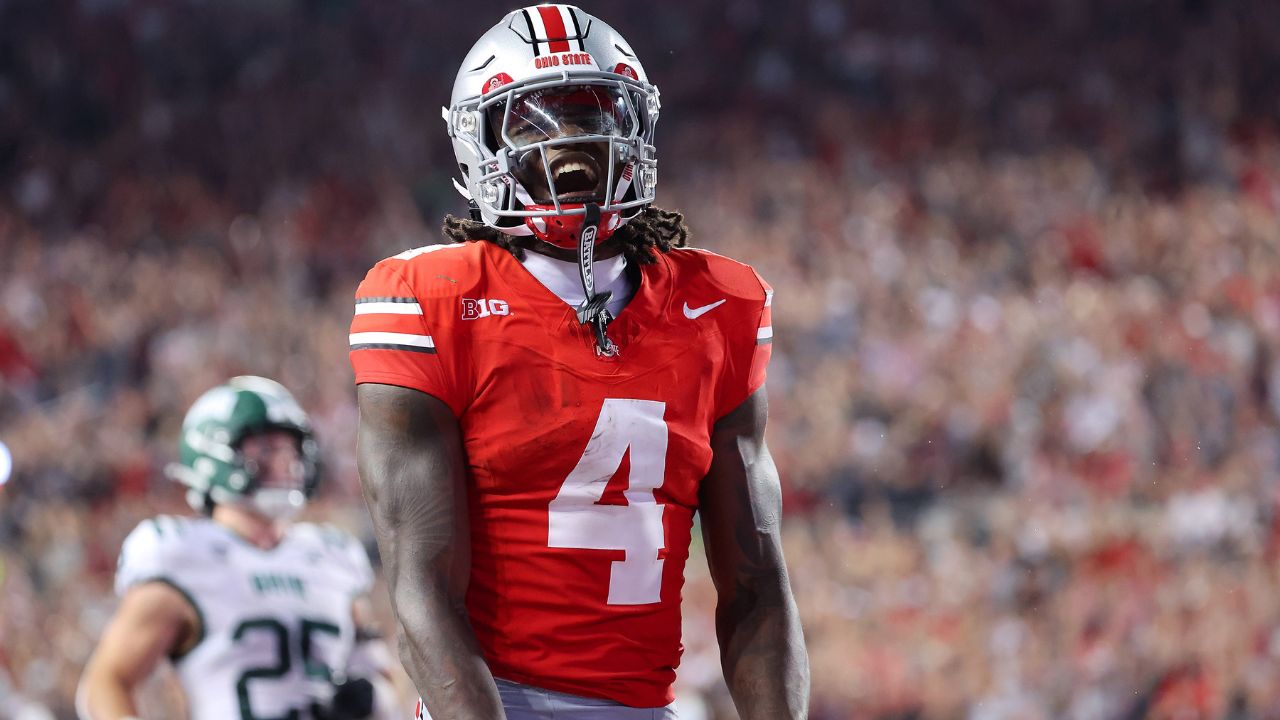
1.01 — Jeremiah Smith, WR, Ohio State
Don’t overthink this one. In a class loaded with elite quarterbacks that would have gone first overall in almost any other season, Jeremiah Smith is still the pick, and it’s not particularly close. He is the most established college receiver prospect since analysts were drooling over Calvin Johnson Jr. before the 2007 draft, and comparisons to Julio Jones are not hyperbole. Every major recruiting service had him as a consensus five-star and the No. 1 overall player, with some calling him the best receiver recruit since Randy Moss.
What Smith did as a freshman at Ohio State was borderline absurd. He racked up 76 catches, 1,315 yards, 15 touchdowns, a Rose Bowl offensive MVP against Oregon, a national championship, and he made Cris Carter’s freshman records look pedestrian in the process.
As a sophomore, now catching passes from redshirt freshman QB Julian Sayin, he battled a minor quad issue and still posted 87 receptions for 1,243 yards and 12 scores. In two showcase performances against Indiana and Miami, two of the country’s best defenses, he combined for 301 yards and a touchdown on just 15 catches. The kid plays up and shines on the biggest stage.
Now entering his true junior season with Arthur Smith as the new OC and Cortez Hankton replacing Brian Hartline at receiver coach, the development infrastructure around Smith remains elite. He is a near-certain top-3 pick in the 2027 NFL Draft and will be a dynasty cornerstone for the next decade. Everyone else is fighting for 1.02.
2024: 76 rec · 1,315 yds · 15 TD | 2025: 87 rec · 1,243 yds · 12 TD | Size: 6-3, 223 lbs
1.02 — Arch Manning, QB, Texas
No player in this class has generated more conversation than Arch Manning, and for good reason. The surname alone puts him under a microscope that most college kids would buckle under. He hasn’t buckled. Manning was shaky early in his first season as a starter, but he steadied himself down the stretch, and the final stat line of 3,163 passing yards, 26 touchdowns, 7 interceptions, and 10 rushing touchdowns at 61% completion, reads like a solid foundation, not a finished product.
The physical profile is legitimately NFL-ready right now. At 6-foot-4 and 225 pounds with real running ability, Manning has an ideal frame and the arm to back it up. The consistency question is real, and he’ll face a stiff early-season test against Matt Patricia’s defense that gave him fits last year. But if Manning cleans up the shaky stretches and goes on a playoff run with Cam Coleman now in his arsenal, the 1.02 price tag could look like a steal in hindsight. The dynasty ceiling here is QB1 for a decade.
2025: 3,163 yds · 26 TD · 7 INT · 61% comp | Rushing TD: 10 | Size: 6-4, 225 lbs
1.03 — Dante Moore, QB, Oregon
If Arch Manning is the quarterback with the biggest name, Dante Moore might be the one with the biggest upside. After a difficult debut at UCLA, Moore looked like a completely different player in Eugene under Will Stein. He was more confident, more decisive, and far more accurate than the raw arm-talent project scouts had penciled him as. Per PFF, he led all of FBS with 30 big-time throws last season. Thirty. That number is not a fluke.
Moore completed 73% of his passes for 3,280 yards with 28 touchdowns and 9 interceptions, while adding genuine value as a runner. At 6-foot-3 and 203 pounds, he has the frame and athleticism to thrive at the next level. His deep ball is a legitimate weapon and his pocket composure has improved dramatically. He can be a touch more erratic than someone like Julian Sayin, but when Moore is locked in, the ceiling is as high as anyone in this class. In a SuperFlex, he’s a must-have asset.
2025: 3,280 yds · 28 TD · 9 INT · 73% comp | Big-time throws: 30 (FBS leader) | Size: 6-3, 203 lbs
1.04 — Cam Coleman, WR, Texas
At Auburn, Cam Coleman never quite became the monster prospect the recruiting services promised. He was inconsistent, the quarterback play around him was a mess, and his production (56 catches, 708 yards, 5 touchdowns in 2025) felt like a guy playing at 60%. But here’s the thing about Coleman: when he was dialed in, he was absolutely unguardable. As a true freshman, he caught 37 passes for 598 yards and 8 touchdowns, flashing the elite combination of size, speed, and body control that made him the fifth overall recruit in the 2024 class.
Now he’s in Austin, running routes for Manning, in a program with genuine offensive infrastructure. He’s still only 20 years old on draft day. The leap Coleman takes in 2026 could be enormous, and dynasty managers who draft him at 1.04 could be getting a top-tier WR1 at a significant discount from where his talent says he should be. High risk, massive reward.
2025 (Auburn): 56 rec · 708 yds · 5 TD | 2024 (freshman): 37 rec · 598 yds · 8 TD | Size: 6-3, 197 lbs
1.05 — Ahmad Hardy, RB, Missouri
⚠️ Injury/Situation Alert — Monitor Closely: Ahmad Hardy was a shooting victim on May 10. He is reported to be in stable condition and expected to recover, per Pete Thamel. Very few details are currently available, and we’ll provide much-needed updates throughout the season.
There’s no true generational workhorse running back consensus in this class, and Hardy’s combination of dominance as a between-the-tackles runner and his resume as the SEC’s leading rusher makes him the default RB1 heading into 2026. He paced the entire country with 25 carries of 15-plus yards last season, which is a number that reflects not just speed, but elite contact balance, vision, and finishing ability. When Hardy gets his pads north-south, he is a load.
The legitimate knock on Hardy is his near-total absence as a receiving option (22 receiving yards last season). In an NFL that increasingly demands three-down backs, that’s a ceiling limiter that will follow him through the pre-draft process unless he addresses it in 2026.
2025: 1,649 rush yds (SEC rushing leader) · 16 rush TD | 15+ yard carries: 25 (FBS leader)
1.06 — Kewan Lacy, RB, Ole Miss
Kewan Lacy led all of college football in rushing first downs last season, which tells you everything about how he operates: he’s a grinder, a chain-mover, a guy who gets what the play is supposed to get and then some. At Ole Miss, he shouldered the full offensive load on a CFP semifinal run, posting 1,567 rushing yards and 24 touchdowns on the ground while adding 29 receptions out of the backfield. The workload alone is worth noting, and he’s already proven he can handle RB1 volume at a high level.
Five drops last season are a concern, though not a disqualifying one. If he can clean up ball security and show he’s a reliable receiver in 2026, Lacy becomes a genuine three-down back at the next level. With Trinidad Chambliss returning to run the offense, the infrastructure is in place for another monster year in Oxford.
2025: 1,567 rush yds · 24 rush TD · 5.1 YPC | Receiving: 29 rec · 177 yds | First downs: 86 (FBS leader)
1.07 — CJ Carr, QB, Notre Dame
CJ Carr is a legitimate sleeper to rise significantly up this board by the time the 2027 draft rolls around. Entering his redshirt sophomore season, he already looks the part of an NFL starting quarterback. His 2.54-second average time to throw (PFF) suggests a player who processes quickly, trusts his reads, and gets the ball out before defenses can affect the play. His 24 touchdown passes against just 4 interceptions in his first year as a starter speak to a poise level far beyond his experience.
There’s a real chance Carr stays in school for another year, which would only strengthen his case. But if Notre Dame makes a deep playoff run and he replicates or improves on last year’s performance, he could challenge for the top quarterback spot in this class. The dynasty community is just starting to wake up to Carr. Get there early.
2025: 2,741 pass yds · 24 TD · 4 INT | Time to throw: 2.54 sec avg | Size: 6-2, 215 lbs
1.08 — Ryan Coleman-Williams, WR, Alabama
Let’s be direct: Ryan Coleman-Williams is not an easy sell. Seventeen drops on 114 career catchable targets is a number that doesn’t disappear, and his stretch run last season of only 116 yards over his final five appearances suggested someone who fades when games matter most. He will need a significant step forward in 2026 to justify staying in the first-round conversation.
And yet. When “Hollywood” Coleman-Williams is locked in, he is a genuine problem for defenses. The freshman tape at Alabama was exceptional with 48 catches, 865 yards, 8 touchdowns, and the physical tools are real. Not to mention his 6-177-1 vs Georgia as a 17-year-old stands out. At 6-foot-0 and 175 pounds, he needs to add some weight for the NFL, but the speed and playmaking ability are already there. Born in February 2007, he’ll turn 20 before the combine. This is a bet on talent and youth. The drop issues are real but correctable. Keep him in round one until proven otherwise.
2025: 49 rec · 689 yds · 4 TD | 2024: 48 rec · 865 yds · 8 TD | Career drops: 17 on 114 catchable targets
1.09 — Julian Sayin, QB, Ohio State
Here’s the quarterback with the most to prove in 2026. Julian Sayin ranked first among all FBS quarterbacks in PFF overall grade last season. He posted a turnover-worthy play rate of just 1.4% (2nd in FBS) while throwing it to the best receiver duo in college football. That combination produced one of the most efficient redshirt freshman seasons the position has seen in years.
However, the scouting concerns are legitimate. He checks in at 6-foot-1 and 208 pounds with only 11 scrambles last year, meaning his size and mobility will be questioned throughout the pre-draft process. He also feasted on a relatively soft schedule in 2025. The gauntlet he faces in 2026 with Texas, Iowa, Indiana, USC, Oregon, and Michigan should answer those questions one way or another. If Sayin performs at the same level against elite competition, the size narrative becomes a lot easier to dismiss. He could easily be a top-6 pick by the time this draft arrives.
2025 PFF grade: No. 1 in FBS | 2025: 3,610 yds · 32 TD · 8 INT | Size: 6-1, 208 lbs
1.10 — Nate Frazier, RB, Georgia
The comparisons to Nick Chubb are not baseless. Nate Frazier runs with that same no-nonsense, north-south mentality, blazing 4.3 speed, surprisingly physical at the point of contact, always falling forward. He plays like he has something to prove on every carry, which is exactly the kind of mentality that produces great NFL running backs. In Athens, where every Bulldog back gets NFL scrutiny attached to their name, Frazier has held up.
The production hasn’t yet crested 1,000 rushing yards in a season, which is the one thing keeping Frazier from jumping higher on this board. He’ll also need to prove himself as a pass protector and improve his hands out of the backfield before he can be trusted as a true three-down back at the next level. But the physical tools and the situation are elite. A breakout 2026 under the Georgia spotlight would make him a top-7 pick.
Speed: 4.3 (est.) | 2025: 947 rush yds · 6 TD · 5.5 YPC | Size: 5-10, 205 lbs
1.11 — Nick Marsh, WR, Indiana
Nick Marsh was one of the most coveted names in the transfer portal, and Indiana, fresh off a national championship, won the bidding war. That context matters. Marsh is heading into one of the best offensive environments in college football, with defending-champion infrastructure, elite coaching, and a program with playoff ambitions. At Michigan State in 2025, he posted 59 catches for 662 yards and 6 touchdowns. In 2024, he caught 41 passes for 649 yards and 3 scores. Steady, reliable, but off the radar in East Lansing.
The 6-foot-3, 203-pound frame is exactly what NFL teams covet, and the talent has never been in question. What Marsh needed was a better situation. He has it now. If he breaks out in Bloomington and uses his size advantage to bully Big Ten cornerbacks the way the tools suggest he can, the 1.11 slot will look like a bargain come draft night.
2025 (Michigan State): 59 rec · 662 yds · 6 TD | 2024: 41 rec · 649 yds · 3 TD | Size: 6-3, 203 lbs
1.12 — Isaac Brown, RB, Louisville
The last spot in the first round came down to a crowded field of QB Jayden Maiava, RB Jadan Baugh, and WR Charlie Becker all crossed my mind, but ultimately, raw talent and a final-year redemption arc won out. Isaac Brown is a different kind of back from the bigger names above him on this board. At 5-foot-9 and 190 pounds, he’s not going to run through anyone’s arm tackles. But he doesn’t need to. He gets to the second level in the blink of an eye, has legitimate pass-catching chops, and has the production when healthy.
As a true freshman in 2024, Brown led Louisville with 1,173 rushing yards and 11 touchdowns on 165 carries while adding 30 receptions. He played only 9 games in 2025 due to injury but still averaged a jaw-dropping 8.8 yards per carry. A healthy final season at Louisville, where he’s expected to be the featured back, could push him into the back half of the first round in real drafts. He’s the pick here on upside alone.
2025: 884 rush yds · 7 TD · 8.8 YPC (9 games) | 2024 (freshman): 1,173 yds · 11 TD · 30 rec | Size: 5-9, 190 lbs
All prospects are expected to declare for the 2027 NFL Draft. Evaluations subject to revision throughout the 2026 college season. Ahmad Hardy’s situation will be monitored as details emerge.
KEEP AN EYE ON (IN NO ORDER):
QB – Jayden Maiava (USC); Drew Mestemaker (Oklahoma St.); LaNorris Sellers (South Carolina); Sam Leavitt (LSU); John Mateer (OU); Trinidad Chambliss (Ole Miss); Brendan Sorsby (Texas Tech); Drake Lindsay (Minnesota); Darian Mensah (Miami); Josh Hoover (Indiana); Nico Iamaleava (UCLA); Byrum Brown (Auburn); DJ Lagway (Baylor)
RB – Jadan Baugh (Florida); Mark Fletcher Jr. (Miami); Justice Haynes (Georgia Tech); Jordan Marshall (Michigan); LJ Martin (BYU);
WR – Charlie Becker (Indiana); Omarion Miller (Arizona State); KJ Duff (Rutgers); Duce Robinson (Florida St.); Bryant Wesco Jr. (Clemson); Wyatt Young (Oklahoma St.); Mario Craver (Texas A&M); Ryan Wingo (Texas); Evan Stewart (Oregon); Cooper Barkate (Miami); Nyck Harbor (South Carolina); TJ Moore (Clemson); Ian Strong (Rutgers)
TE – Jamari Johnson (Oregon); Trey’Dez Green (LSU); Terrance Carter (Texas Tech); Peter Clarke (Temple); Luke Reynolds (Virginia Tech)