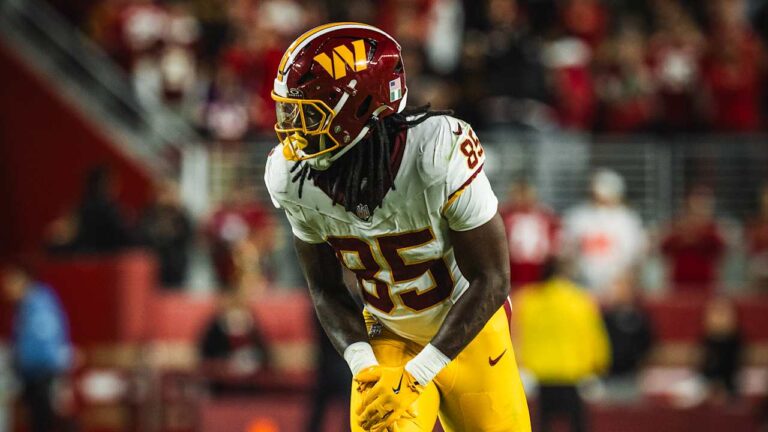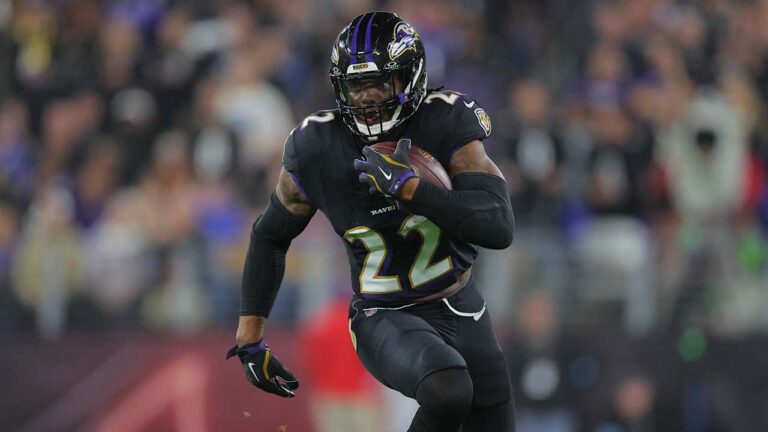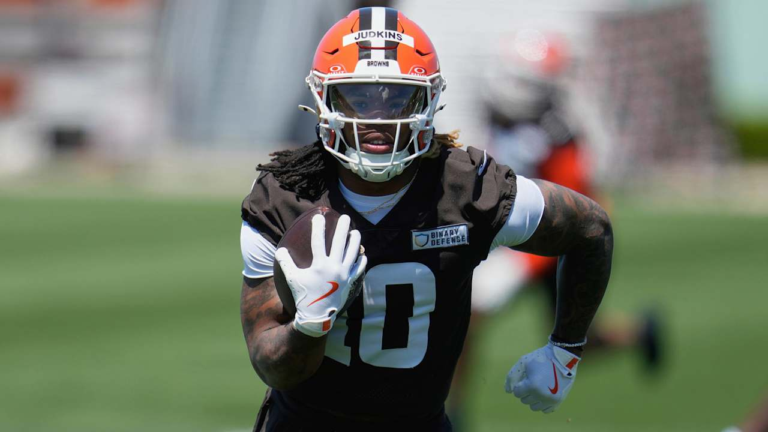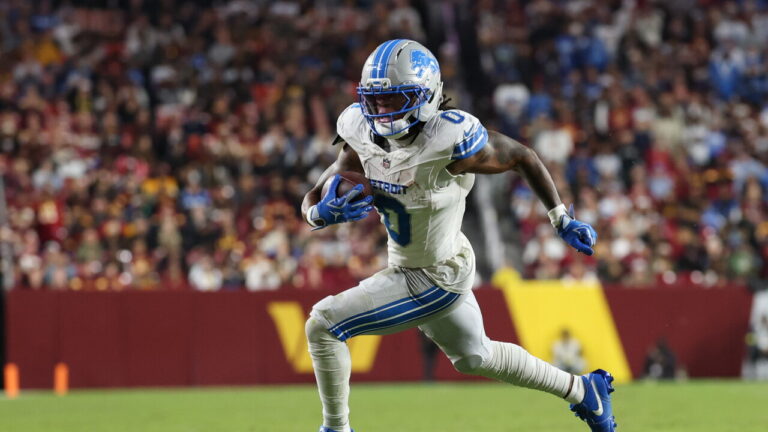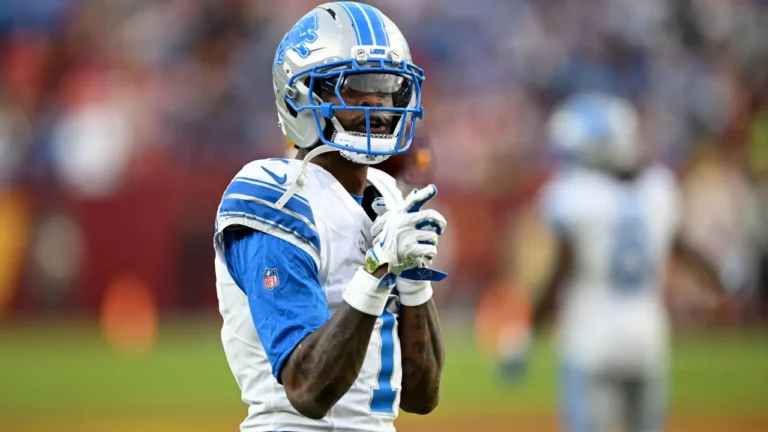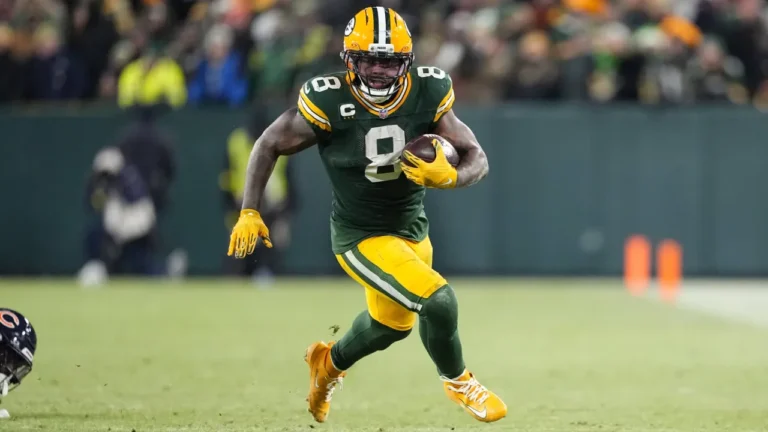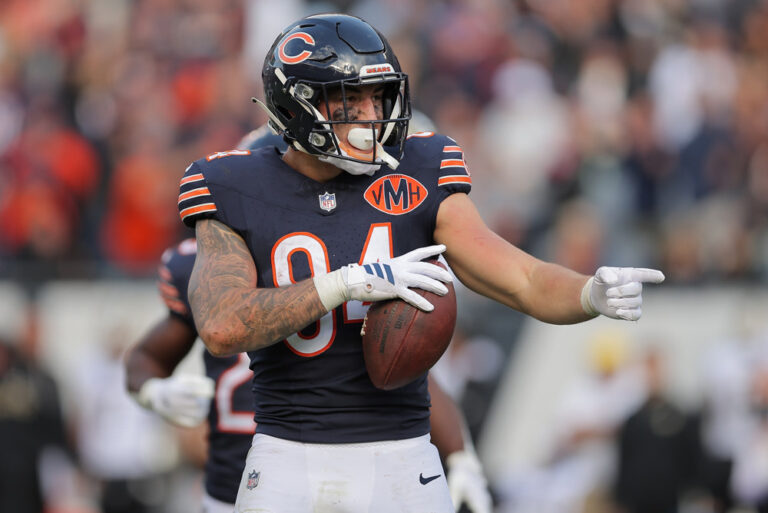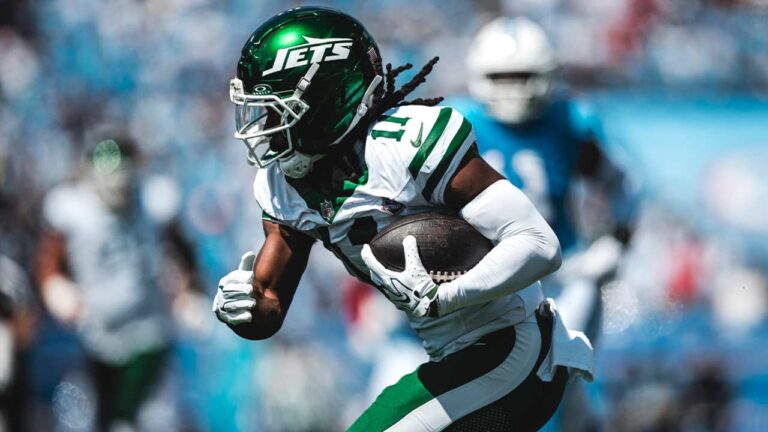
We’re about halfway into the 2026 season, and you’re confident that your team is a legitimate dynasty contender. You have a strong record and a high Points For total. A playoff berth looks all but guaranteed. Like on any battleground, staying still can get you killed. Staying calculated and diligent with your roster moves can make the difference between seeing your name in the finals bracket and playing for third place.
Most dynasty fantasy football leagues have 12 teams and use a Superflex (two-quarterback), so the rest of the article assumes that format. Here are six savvy moves to make right now for contending dynasty rosters:
The Goal is WAR
Wins Above Replacement (WAR) measures how many wins a player adds to your roster. A replacement-level player is defined as a player at a given position who’s available on the waiver wire. This is the mathematical baseline that represents a zero-cost, emergency fill-in that any manager can pick up and start without spending draft capital or trading assets.
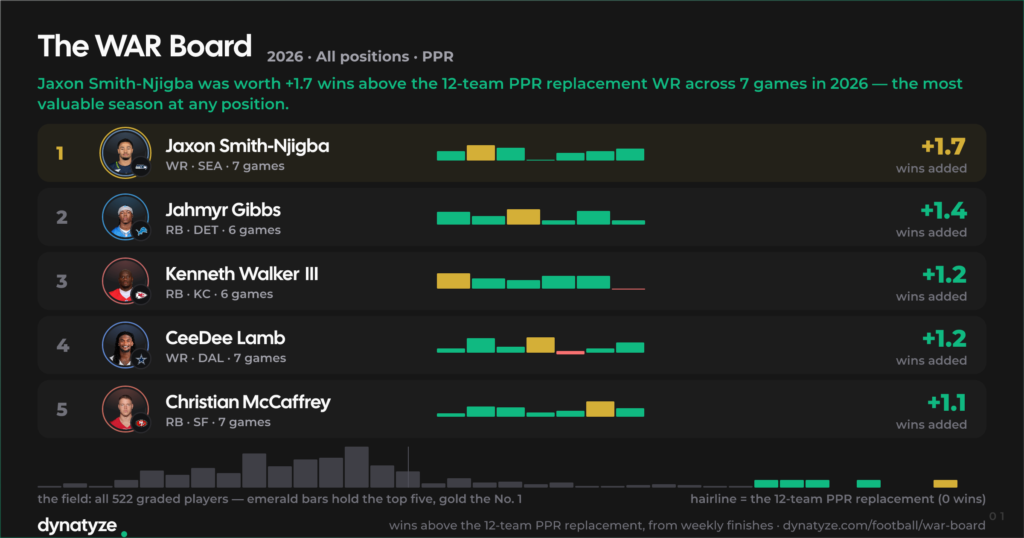
We want to prioritize players with high floors and guaranteed volume to build a mathematical margin of error rather than relying on luck-based variance. The math on WAR in shallow starter formats, like nine starters, suggests you want as many “hammers” or stud young fantasy producers, as possible. The math on WAR in deeper leagues, like 11 starters or 14 teams, suggests it’s better to build quality depth to protect your floor from zeroes due to attrition over the season.
1. The RB Hammer and Anti-Roster Fragility
Unless you’re a wide-receiver-factory team or play in a league that heavily rewards tight ends, most dynasty contenders are better off starting quality running backs at flex. The math explains why: a starting running back typically has a floor of 15 touches per game, while a WR2/3’s floor and ceiling are more volatile.
A strong dynasty contender should roster four to five starting-caliber running backs who can play through the fantasy playoffs. Unlike other positions, running backs are heavily influenced by the offensive environment around them. A backup running back can slide in and start producing at a high level, but we don’t typically see that as easily from backup tight ends or wide receivers.
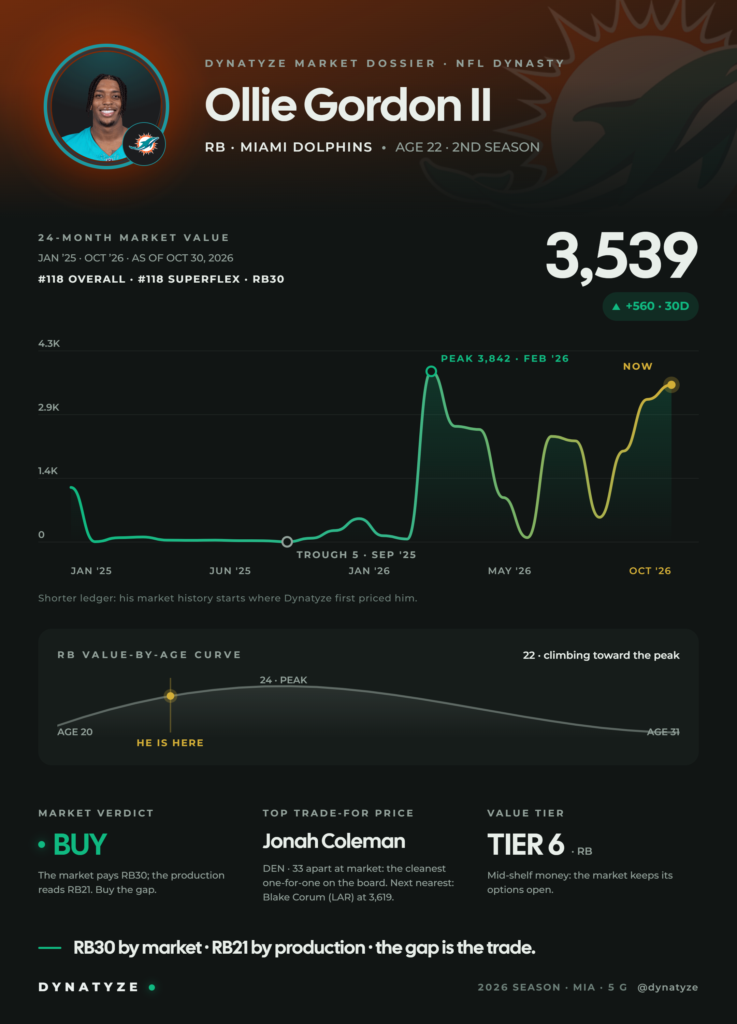
Look at what Dolphins backup Ollie Gordon has done for a couple of spike weeks while DeVon Achane has been out, or what Jets backup running back Braelon Allen has done while starter Breece Hall has been out. Injuries and trades can make backup running backs skyrocket in value for contenders; take advantage when the time comes, especially if they can hold down the gig for a long time.
A rebuilder’s bench is typically full of “Lotto Ticket” players, whose goal is to move in ways that add value without disrupting their chances of earning an earlier rookie draft pick. A dynasty contender’s bench should be full of backup running backs. Why? First, running backs get hurt slightly more often than wide receivers.
Data shows that top-tier RBs miss time 44% of the time, while top-tier WRs miss 35%. Second, if a WR1 goes down, targets typically spread out or funnel to the tight ends, though not always. If an RB1 goes down, sometimes the backup captures ~80% of the workload.
The Takeaway: At a certain point in your roster depth, it’s often better from a WAR standpoint to hold as many running-back handcuffs as possible, given the value they can add if the guy ahead of them goes down.
2. The “Any Given Sunday” Excuse
I’ve seen many people claim that they just want to make the fantasy playoffs, where anything can happen. While that is somewhat true, you can still position yourself as a dynasty contender to compete in the playoffs. Relying on variance is risky; instead, focus on reducing your margin of error.
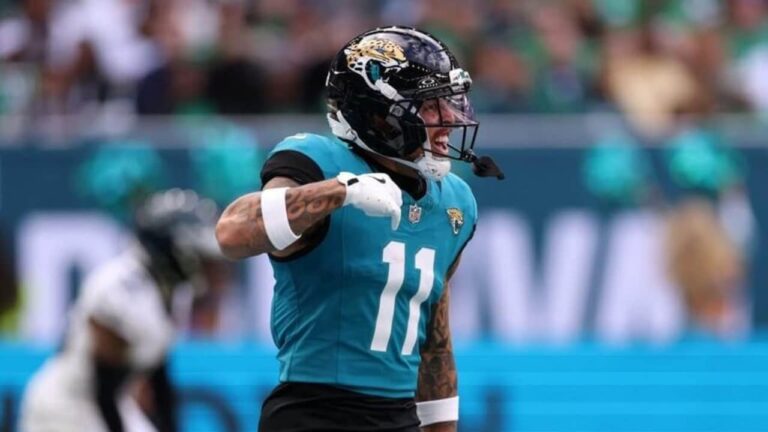
You don’t want your WR4 or WR5 to be a hit-or-miss rookie like the Buccaneers’ Ted Hurst, who’s only flashed a couple of times but isn’t a confident starter yet. Instead, you want a boring but reliable veteran with a proven track record and a solid fantasy playoff schedule, like the Jaguars’ WR Jakobi Meyers, to protect you if your starter gets injured in the playoffs. Fine-tuning your roster before it’s too late is the extra step sharp contenders make to avoid roster fragility.
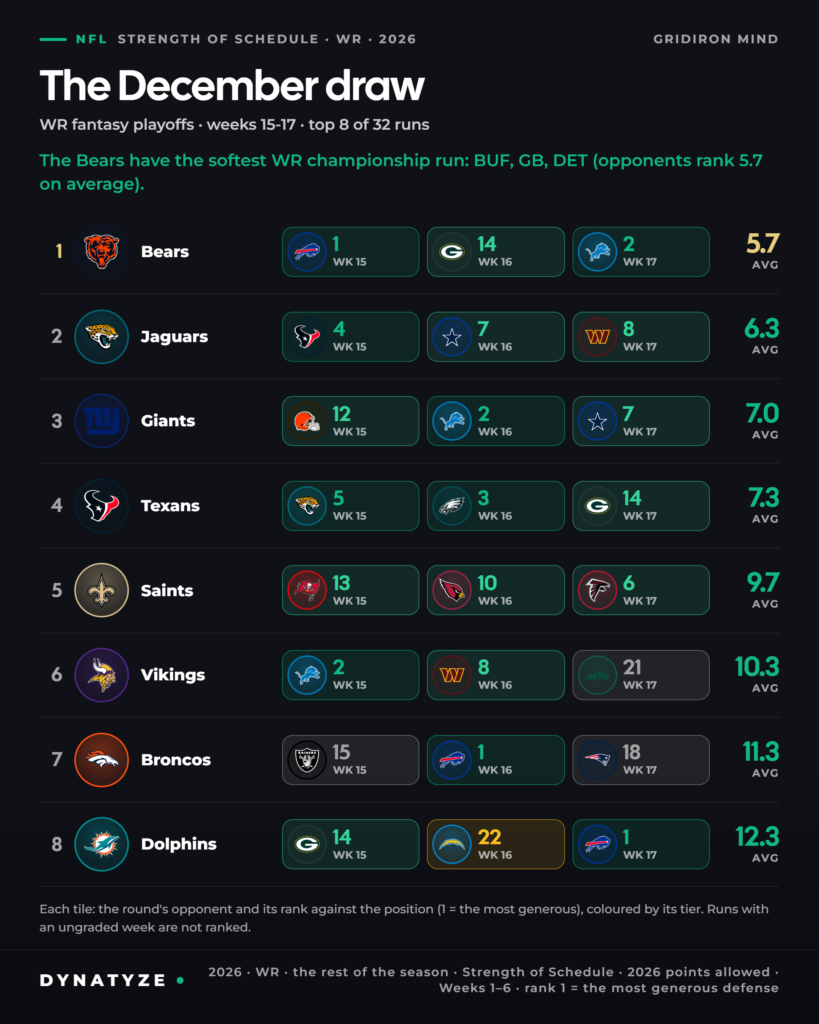
The Takeaway: Boring veterans can help you win championships. The floor that they can provide for a dynasty contender’s roster can make the difference in those close matchups or if you catch the unfortunate injury bug.
3. The “Dead Asset” Arbitrage
Rebuilding teams typically want to avoid players near or past the age cliff at each position. This creates a trade-market opportunity where both sides “win.” A rebuilder sheds points and gains liquidity or youth, while a dynasty contender gets points now.
Players labeled as “dying assets”, such as Aaron Rodgers, Derrick Henry, Mike Evans, and Travis Kelce, are all examples of players with a short remaining shelf life, but are capable of putting up significant points for contenders this year. Typically, these players won’t cost a king’s ransom, so while everyone wants the shiny new toy, you can acquire them fairly cheaply compared to younger players averaging similar points per game at the position.
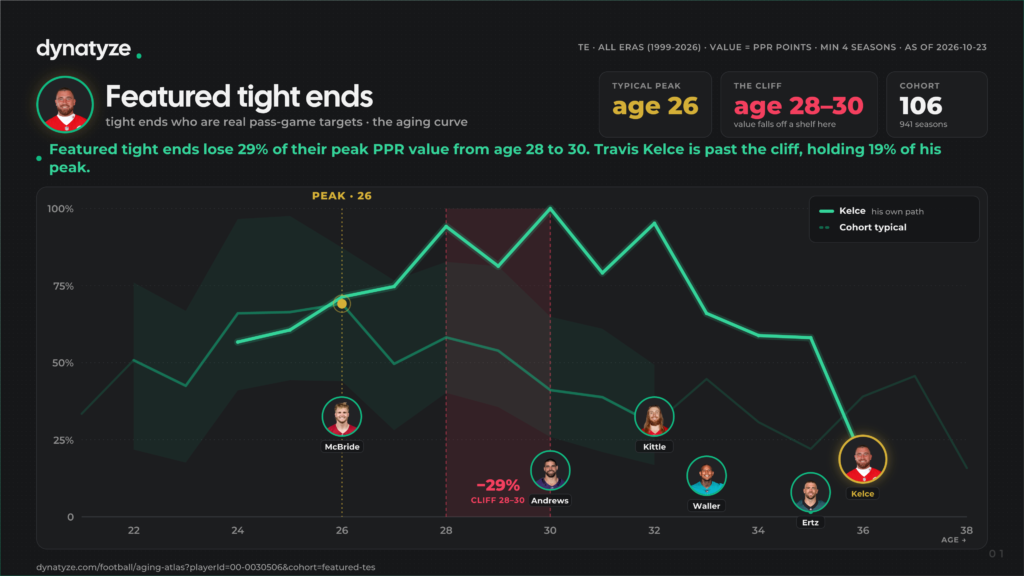
Now that we’re deeper into the season, teams that thought they were strong contenders at the start may see the writing on the wall based on their record and no longer want to risk keeping players who won’t carry the same value into the offseason. Paying a 2nd-round or later pick, which typically has a 20-30% or worse chance of producing top-24 numbers at their position, for starter-caliber production can be a league-winning move for a contender still navigating injuries and bye weeks.
The Takeaway: Dynasty is a value game first, but contenders and rebuilders value different things. A rebuilder has no business owning a year-to-year rental player, whereas a contender certainly does. Paying a lottery-ticket price essentially to get points now makes sense when you’re trying to win right now.
4. The Insulated Pivot
If you’ve read any of my other content, you’ve probably heard me preach that dynasty is a value game first and a fantasy football game second. Many managers miss this, insisting contenders need to worry less about value and more about winning. You can, and should, try to consider both when making your moves. You can strengthen your roster as a dynasty contender while keeping or elevating its value. That’s why we want to make insulated trades.
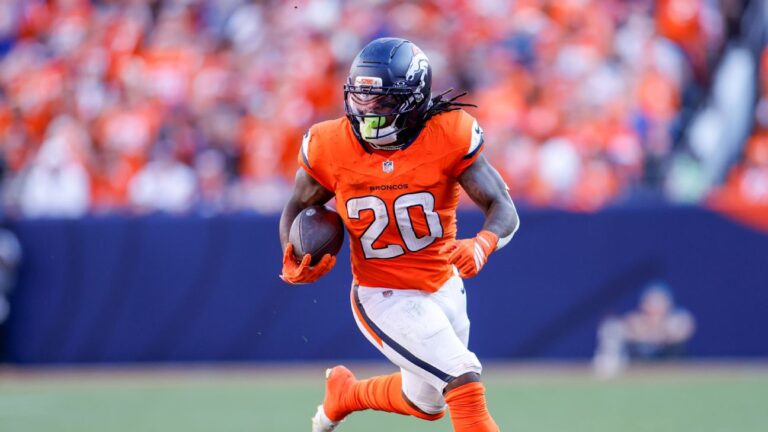
Many managers focus on one-for-one ratio trades, like sending a future first to get a quality starter. While this kind of trading has a place, the real wins come from completing an insulated trade. You’re not just burning value to acquire points; you’re trading youth and hype for production and liquidity. For example, as a dynasty contender, you might consider trading a high-end, but out-for-the-year piece like DeVon Achane for a solid producing veteran like Derrick Henry plus a first-round pick.
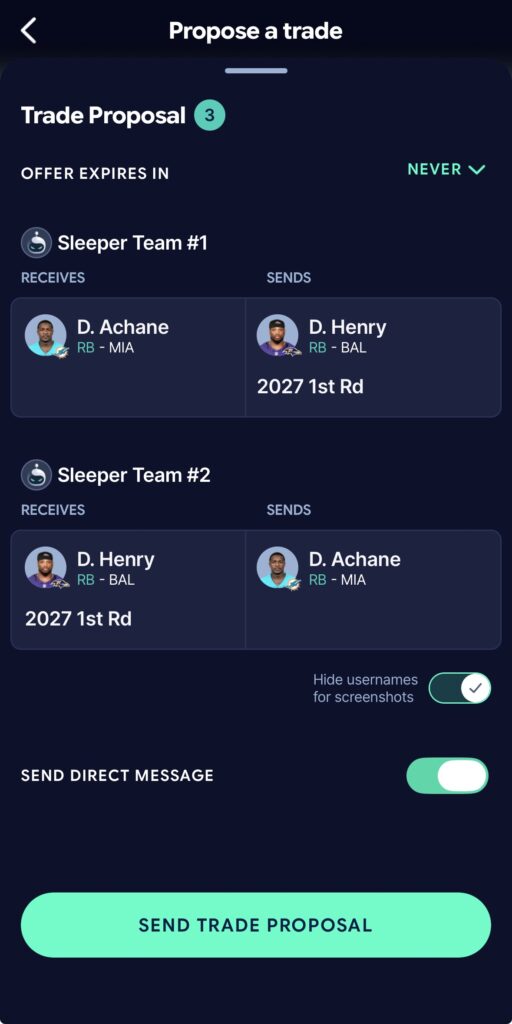
With insulated trades, you get a more consistent player with a similar or potentially higher current-year ceiling, though they may be older, while also protecting your team’s value by adding the first-round pick to save or use as needed. The rebuilding team gets the younger, higher-ranked asset.
The Takeaway: Hype causes player valuation, especially by general consensus, to skyrocket. This doesn’t mean the hyped player won’t be good, but contenders can make trades to insulate their roster with more consistent, veteran production while increasing or maintaining overall roster value.
5. The “Tier Down” at Quarterback
Josh Allen has long been considered the fantasy QB GOAT, but you don’t necessarily need him to win your fantasy team. You need the most total points and to make the right roster decisions. Tiering down from quarterbacks is one of my favorite ways to strengthen my overall roster as both a dynasty contender and a rebuilder.
Here’s how the math operates, and where the trade calculators fail. You tier down from a consensus-ranked dynasty QB1, like Trevor Lawrence. In return, you get a plus over someone like Jared Goff, who’s been a fantasy QB1 for several years and still is, but is ranked as a dynasty QB2 because of his age. The plus is where the contending value is made.
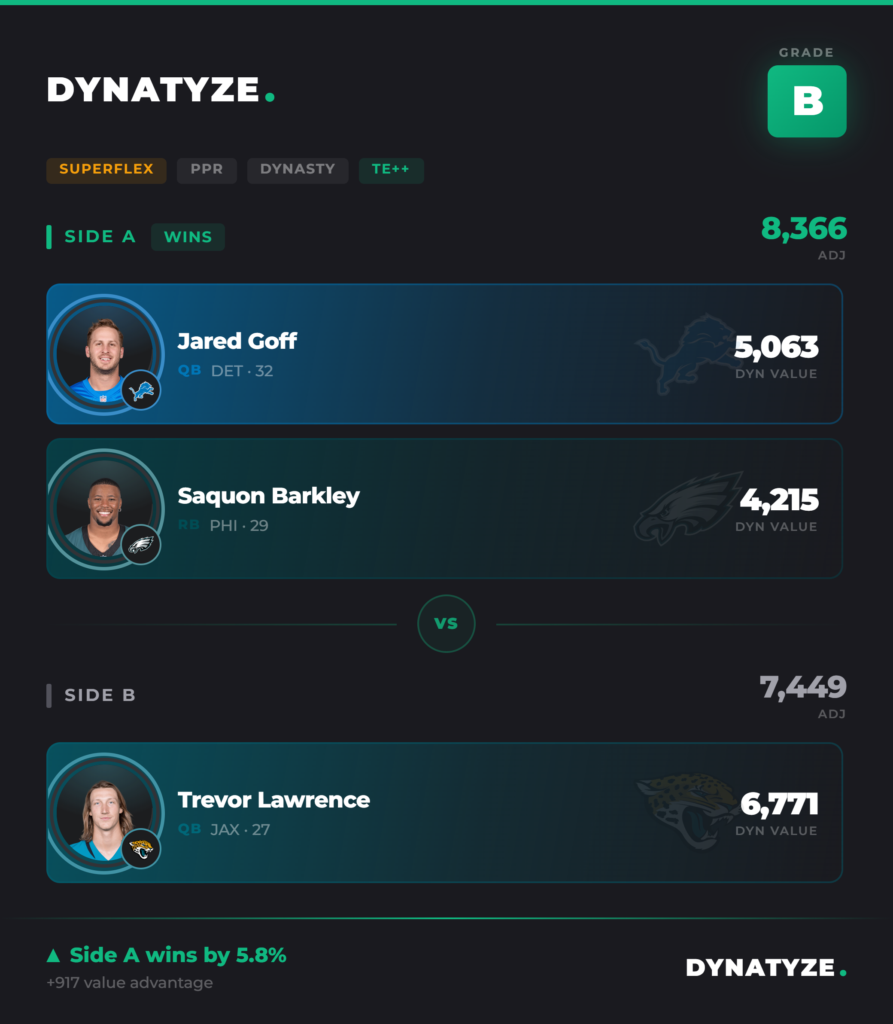
It’s fair to project a similar fantasy points-per-game average for the quarterbacks over the next three years, so if you can add an extra starting running back or wide receiver, your roster’s production value just increased. Youth matters, but quarterbacks age the best, and Goff is far from an old/dying asset like Matthew Stafford or Aaron Rodgers.
The Takeaway: You don’t need a dynasty QB1 to win. Tiering down, when the value is right, can give your roster the edge you need to put it over the top.
6. Draft Picks Are Currency, Not Family
Many dynasty managers hoard picks and believe that this is the best way to “gain value”, but that’s not necessarily true. Dynasty is a value game first, but it depends on context. If you’re a rebuilder, sure, picks are going to be much more valuable to you. But if you’re a strong contender, picks give you purchasing power. They’re potential energy you can turn into kinetic energy for your playoff push.
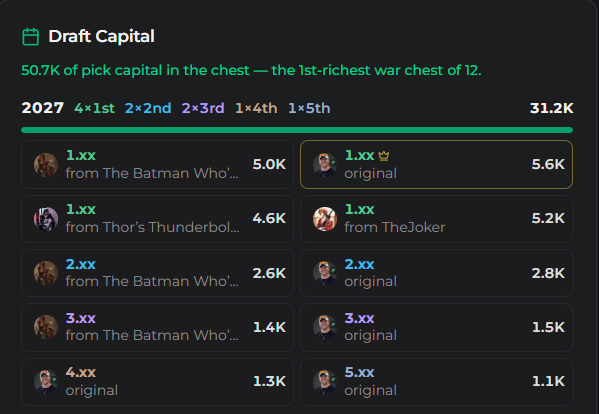
Many managers go all in too soon or irrationally send out their first-round picks without an honest roster audit to see whether they are a strong contender. Ask managers who sent out first-round picks earlier this year for Saquon Barkley, Jaylen Waddle, and Travis Etienne how they feel right now.
None of these players have lived up to the price tag and aren’t worth a first in the current market. Market timing is critical; if your roster isn’t as strong as you thought, or if you suffer terrible luck with the injury bug, you can end up pigeonholing yourself. It makes sense to set a timeframe to decide whether to retool for next year or go all in this year.
Generally, unless I can get an amazing deal done, I’m patient with my future first-round picks. I like to wait until just before the trade deadline, or before the playoffs if you don’t have one, to make my move. I have a standard rule for players I’m willing to pay a first-round pick for: they must provide top-15 production at their position for more than two years. This avoids sinking premier value into a one-year rental player, which we see time and time again.
The Takeaway: Picks are ammo, but we don’t want to empty the clip without precision. Make sure you understand the window you’re paying for, and give yourself guidelines to live by.
Winning is a Ruthless Business
Dynasty is still a value game first, but depending on where your roster stands, that value can shift from youth and draft capital to current production. Either way, you still need to be diligent and make calculated moves if you want the best chance to win it all as a dynasty contender. Remember, dynasty isn’t about winning once; it’s about setting yourself up for long-term success for multiple shots at the title. Moving erratically, like standing still, just makes you an easy target for the true predator in your league. Want to know if you’re a strong contender? Check out this article on how I do my own self-audits: Dynasty Roster Audit: 5 Proven Steps to Expose a Pretender.