We’re now headed into Week 6 of the 2026 fantasy football season, and your team sits at a 5-0 or 4-1 record, and you’re starting to think you’re a title lock. Too often, managers skip a mid-season dynasty roster audit because they get too comfortable and stop evaluating their team objectively, letting box scores and a winning record lull them into a potential trap.
The sharpest players constantly analyze their team, and they look for ways to boost both long-term value and immediate contention strength. You can, and you should, do both.
How to Run a Dynasty Roster Audit: Contender or Pretender?
If you want to run this audit on your own team, pull up the ‘My Leagues’ tab on Dynatyze. We’ll use it to analyze one of my own contending rosters and see whether it’s built to survive.
1. Schedule Luck & “Asterisk Standings” Stress Test
Records can give you a false sense of confidence. Points For (PF) tells the truth, and the all-play record exposes the frauds. Before you start hammering your league’s trade block for win-now moves, you should cross-reference Standings with Schedule Luck and Asterisk Standings. An all-play record is what your record would be if you played every team in the league each week, and Asterisk Standings strips away any luck and re-ranks the league as if everyone played the entire field each week.
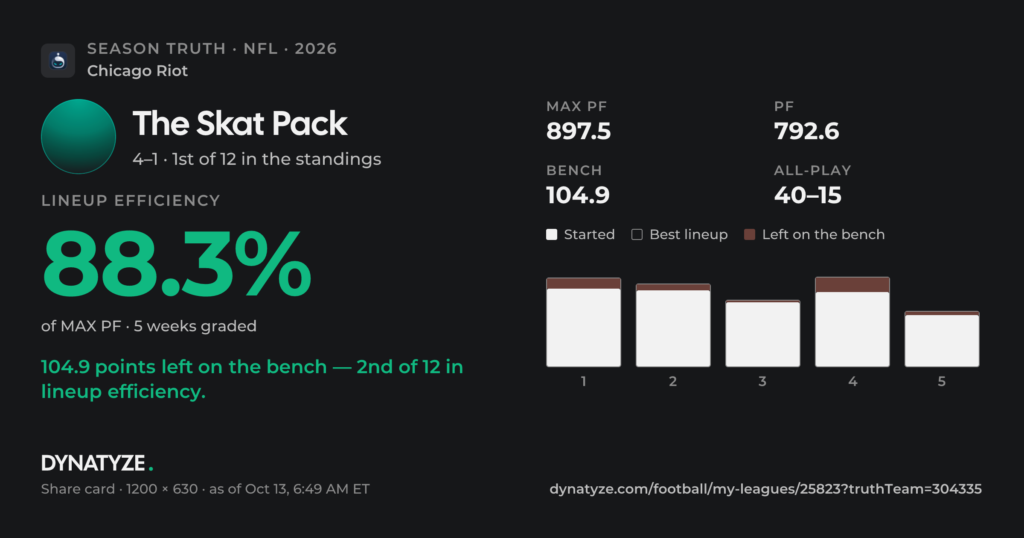
The Contender Signal you want to look for is being Top-3 in PF and having an expected win total that matches your actual record. The Paper Tiger Trap Signal shows a 5-0 or 4-1 record while ranking sixth or worse in PF because you caught league mates in their lowest-scoring weeks or faced managers actively looking to tank.
Using one of my dynasty teams, you can clearly see it passes Step 1 with 897.5 PF through Week 5, second in the league in terms of lineup efficiency. True contenders don’t just beat up on the bottom half of the league. Checking WAR and Schedule Luck can show you how many of your early-season wins came from bottom-four teams.
2. The Positional Shelf Audit (Hoarding Value vs. Starting Points)
Value vs. Starting Points is a fun debate across the dynasty fantasy football content space. Accumulating both is a skill. Like weight training, you can build muscle and lose fat if you follow the right process. The trap isn’t holding high-end value assets; it’s dead-ending liquid value into dead bench capacity.
The Scouting Board section shows each team’s strengths and weaknesses. This can help you identify where you need to shift your attention on your own rosters, and where you could find someone interested in trading with you if you have something they need. The process that works for me is using my highest-capital rooms to fuel my starting slots on my contending teams, while keeping my secondary assets, be it players or draft capital, liquid enough to tier across positions.
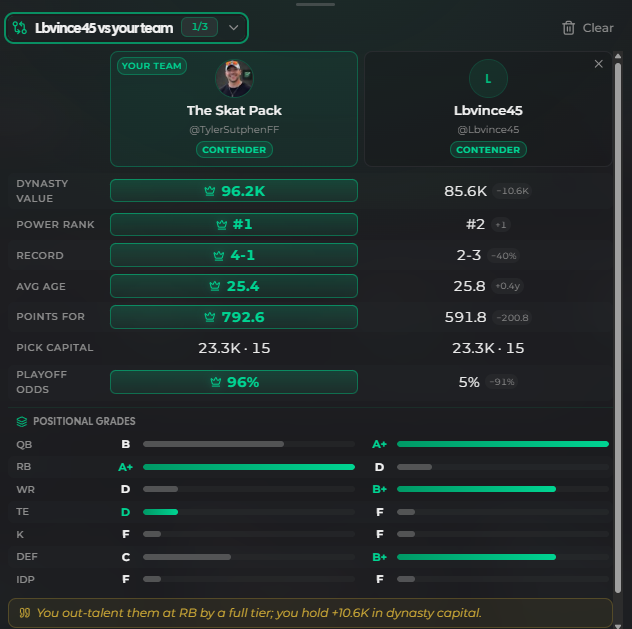
The Contender Signal is dominating your starting lineup spots without disproportionate value on your bench. Your surplus value (young, insulated players or draft capital) lets you pivot if and when needed, such as when the inevitable injury bug hits. Until then, this surplus value continues to compound as players develop into their prime, or as draft capital rises in value toward the end of the year, when people already know where they stand for the playoffs. Non-contending teams will be more interested in draft capital at this point, since they have to accept they aren’t making the playoffs.
The Paper Tiger Trap Signal occurs when a team hoards illiquid assets, particularly at a specific position, leaving them unable to field a starting lineup because league lineup settings and other constraints prevent them from scoring points that count. Your team value climbs on a calculator, but your starting roster bleeds points because they can’t contribute.
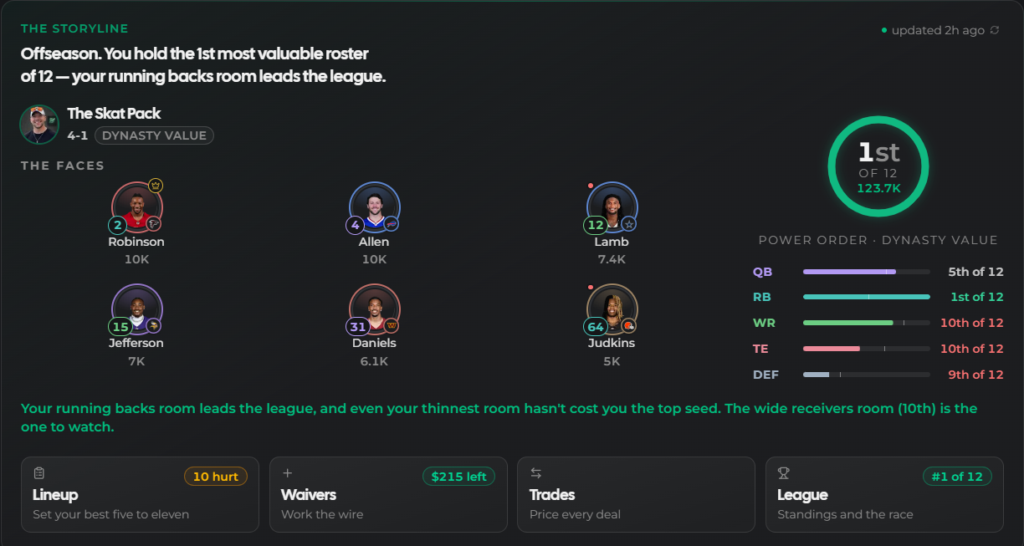
Here’s how I’m trying to navigate this competitive team given how much value I have at the running back position:
3. The Injury & Bench Ledger Reality Check
This is where teams get exposed. It’s easy to ride the high of an awesome starting lineup, but it’s nearly impossible to finish a fantasy football season unscathed by injury while also avoiding even a slight impact from bye weeks. This is where a strong, value-insulated roster lets you make moves that teams that went all-in too early can’t.
In the Lineup section, scroll down to Injury Report and Bench Ledger to see which positions need attention because there’s no current backup option. Having a bullpen, or at least the ability to buy one, is critical for mid-season crisis management. If your roster is stacked with aging players with low-value insulation, you’ll struggle to move them for a valuable return. Injuries hurt any player’s value, but they especially tank an aging player’s value.
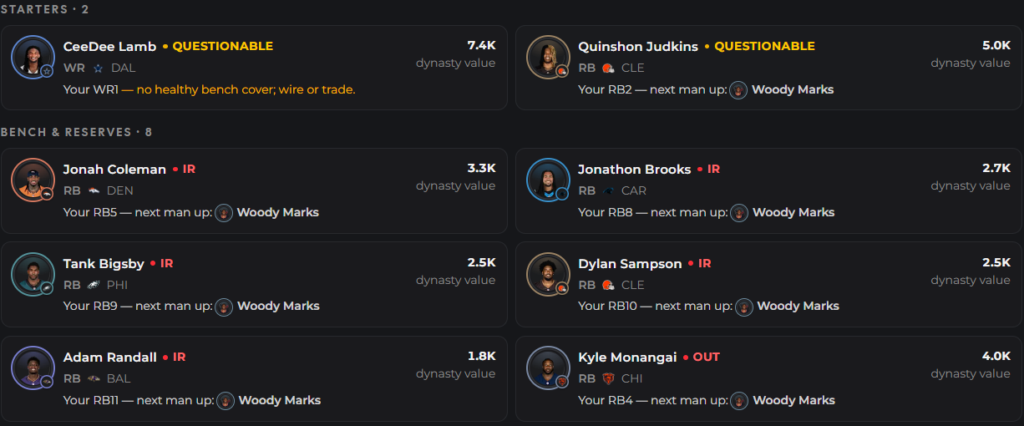
The Contender Signal is a roster that shows usable, high-floor rotational options who can slide into a starting roster spot without crushing your weekly projection. The Paper Tiger Trap Signal is when you have high overall roster value but a massive grouping of injury-tagged players, with no ability to address depth if or when the time comes.
Look at De’Von Achane. Most fantasy analysts ranked him an A-Tier running back entering the season. He recently suffered a season-ending knee injury, but his overall dynasty value isn’t in the gutter. He’s insulated because he’s younger and he has a contract. As a result, he’ll likely fall at most a round or two in dynasty startups next year, but you can still get a decent return in a trade.
Now compare that to Saquon Barkley, who’s also failed to live up to many people’s preseason expectations but is also dealing with a nagging hamstring injury. He was valuable when he could score points, but because he’s hurt and older, people are less forgiving. Unless he bounces back significantly this season, his value will keep falling. No rebuilding team wants him because he’s old. No contender team wants him enough to pay a good value return because he’s old and injured. He’ll likely go multiple rounds later than he did in dynasty startups this year.
As an honest, open dynasty roster audit, I need to address the wide receiver position, as it’s one or two injuries away from becoming a problem for me. Fortunately, my roster has the flexibility to address this issue, and I have options:
- I still have most of my Free Agent Acquisition Budget (FAAB), so I can see what’s available on the wire (this league has shallower benches than my other leagues).
- I still have all my draft capital, so I can make something happen with a rebuilding team, and we have several in this league – this gets addressed later.
- Lastly, I have plenty of young running backs, so I can pair a couple of them to snag a quality wide receiver option from any team, depending on how they value the running backs I own.
As you can see, I’m far from being stuck in the mud, but I’m working to address it before it becomes an issue.
4. The Competitive Window & Age Runway Check
A common phrase in the dynasty community is, “We play in three-year windows.” While dynasty is meant to be played forever, the reality is that the average dynasty league lasts about three years. Hopefully, you have a quality commissioner, functional bylaws, and a strong group of managers so you don’t become a statistic.
The goal of fantasy football is to win. The goal of dynasty fantasy football is to keep your team’s ability to win year after year as high as possible for as long as you can. That’s why it’s called “dynasty.” That is why dynasty is a value game first, and a fantasy football game second. Value can put you in a position to win consecutively, rather than forcing you to tear everything down and rebuild for years because you went all in for one championship.
The Competitive Window module below shows whether your team is approaching, in, or sleepwalking out of its prime. The Contender Signal is a core age between 24 and 26, with your peak scoring window aligned with the current season and a strong backstop of young, prime talent. The Paper Tiger Trap Signal is when aging talent makes up more than 30% of your roster. This is where your roster value can fall off a cliff without warning, leaving you weak and open to bad trades.
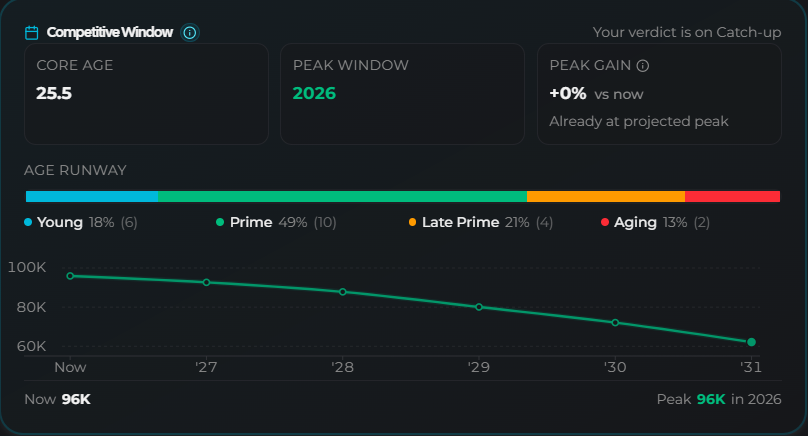
As you can see from my own dynasty roster audit, my roster is very strong in this area. My team’s average age is 25.4, making it one of the youngest competitive rosters in this league. The roster is in peak scoring form because it’s built around valuable, point-producing players: Josh Allen, Jayden Daniels (if he stays healthy), Bijan Robinson, Quinshon Judkins, CeeDee Lamb, Justin Jefferson, and Ladd McConkey. This window is projected to stay open until 2029 without ever needing a complete teardown. At worst, I’d need to retool and could stay competitive for several more years, which is exactly where you want to be when playing dynasty.
5. The War Chest & Arbitrage Liquidity Test
The final step in the dynasty roster audit process is to check how much gunpowder you have in reserve to patch holes before the deadline or, if you don’t, during the playoffs. This is where the value game really can help you win. While other contenders are barely scraping by because of injuries or a rough rest-of-season schedule, you’ve built up value to add depth when teams need to be at their best.
Here, we cross-reference our draft capital with the Arbitrage Board and Trade Builder tool. The site suggests where to start trade negotiations based on your league’s objective team needs. No one likes a trade offer that makes zero sense, so starting from a strong position is critical for quality trade negotiations.
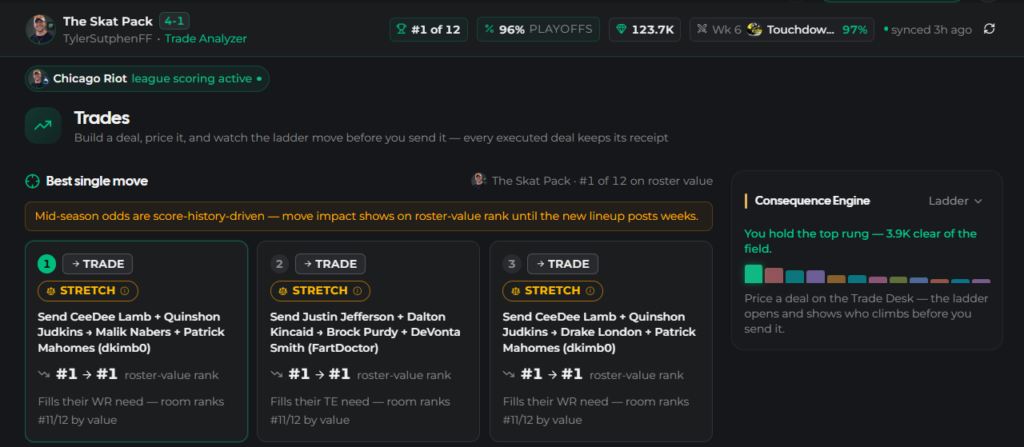
The Contender Signal is where you hold all your original future picks and young assets, plus any surplus from previous trades. This lets you effectively “buy your championship” if you need to make a purchase for your playoff push. The Paper Tiger Trap Signal is when you rank near the bottom in pick value and have no tradeable bench assets, leaving you unable to adapt when disaster strikes or other contending teams make their push.
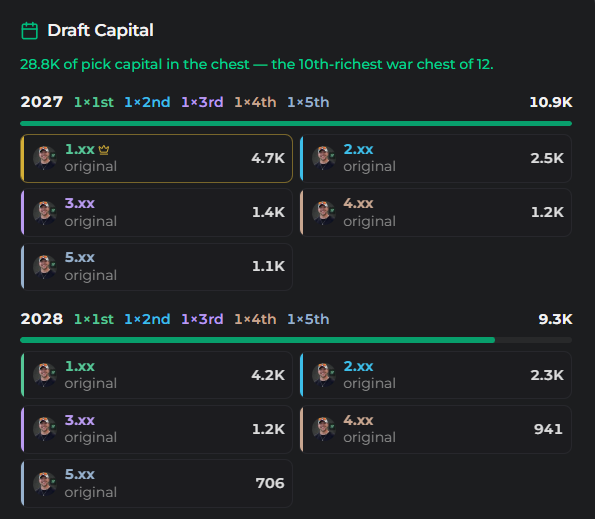
While I have all of my draft capital, I currently hold no one else’s picks. With my 2027 picks projected to be late, I may also have to move some players around, like the bevy of running backs I currently own. Either way, I still have solid options, though I’m stronger in this area on some of my other contender teams.
The Verdict
With this team as an example, I’m in a good, if not great, position to win it all again with my roster. However, if I weren’t constantly auditing my team’s dynasty roster, I’d miss weak spots I could plug before I’m forced into a weak position. This league is a non-Tight End Premium (TEP) league, so it’s not worth getting an elite tight end since I already have a top-12 option in Kincaid. We still play defenses in this league, which I don’t like, but we know it’s just a stream-worthy part of the roster. So this roster needs to address the wide receiver position, which I’m currently working on in trade negotiations.
The worst thing you can do after starting the season with a winning record is get complacent and cocky. You need to comb through your roster regularly and assess potential weaknesses; something happens, and you end up in a bad position. Now you have to make decisions you could have avoided if you’d been more proactive.
If you like this content, you can find more of my material on X/Twitter on my page @TylerSutphenFF where I discuss all things dynasty and fantasy football!