The 2026 NFL season is less than a week away, and we’re going to see the same rookie dynasty mistakes being made again. Every year, more people flock to dynasty fantasy football as a fun new challenge. If you’re like me, you came from a redraft format background, where you drafted an entirely new team each season.
When you first joined a dynasty league, you probably tried your best to avoid being the FNG by consuming various forms of dynasty content and following some expert’s rankings. Unfortunately, not every content creator is going to provide you with everything you need to be successful right off the bat. It’s a tall task. However, novice managers repeatedly make major dynasty mistakes. This can destroy a roster and set them back years!
4 ROSTER-BREAKING DYNASTY MISTAKES
Dynasty Mistake #1: Blind Hubris
Have you ever played paintball, rushed into a building, and got absolutely smoked by an opponent because you went full steam ahead with zero awareness? It’s not a great feeling as you wipe the paint from your face because of your own hubris. Similarly, players new to dynasty fail to understand how valuable draft capital really is, particularly future first-round draft picks. Everyone wants to try to contend right away, but that’s not always the best strategy.
These managers see a popular YouTuber suggest something like, Christian McCaffrey is worth a late first-round pick in dynasty. Because they think that they are contending, they naturally assume that their first is late. Meanwhile, their roster is extremely top-heavy, with no concern for roster depth for the inevitable injury management. These are the same managers who make the mistake of trading up too aggressively in dynasty start-up drafts because they need to get their guy instead of understanding that dynasty is a value game first.
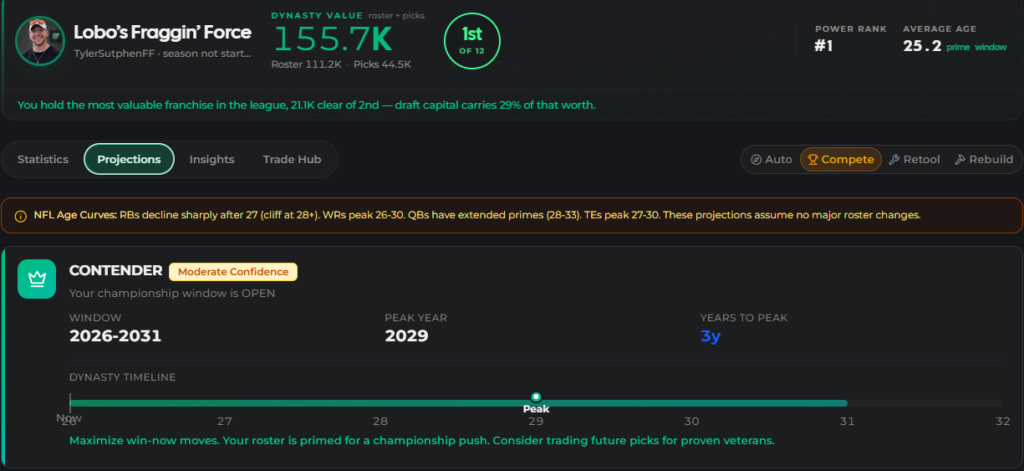
To avoid this dynasty mistake, I recommend you take a step back and objectively grade your roster at each position. Are your quarterbacks the future of their respective franchises? Ideally, you have three options for injuries and bye weeks. Do you have at least four viable starting running backs? Are your wide receivers either entering their prime or still in it, while also commanding a significant target share? Is your tight end a difference maker or just a touchdown-dependent option? These are some easy questions to ask yourself as you do a quick roster audit. We have a tool at Dynatyze that helps you audit each team in great detail, with a preview shown below:
After you’ve discerned that you’re actually a contending roster, instead of a pretender, you have to strategically move your draft capital. I don’t typically recommend moving first-round draft capital, especially picks more than a year out, unless you get a pristine deal done, because you can pigeonhole yourself rather easily. I would never pay a first-round pick, even if it’s late, for a running back who’s both shown that he’s in decline and past the age curve. That’s just terrible process. If you’re paying a first, you want multiple years of quality production. Not just a one-year rental. This dynasty mistake can, and has, set many managers back multiple years.
Dynasty Mistake #2: Disrespecting Father Time
Eventually, all players become irrelevant for fantasy. Alvin Kamara was a week-winning running back for years until he completely fell off. Each position has different age curves, so you can’t just make the dynasty mistake of assuming they’ll remain viable because they were last year. When they start to show signs of decline, you need to pay attention. This isn’t something you can always pick up by looking at the fantasy box scores. This is where advanced stats become crucial in player analysis.
The quarterback position typically ages the best out of all positions, assuming the arm talent holds up. Mobility, if that’s a defining trait, typically falls off sooner. This is why you see pocket quarterbacks like Joe Burrow hold onto value longer than quarterbacks like Jalen Hurts, who rely heavily on rushing production for fantasy output, despite both having similar fantasy ceilings and different ages. Typically, we see rushing-reliant fantasy quarterbacks peak before they turn 30, as their rushing efficiency often takes a nosedive around that time.
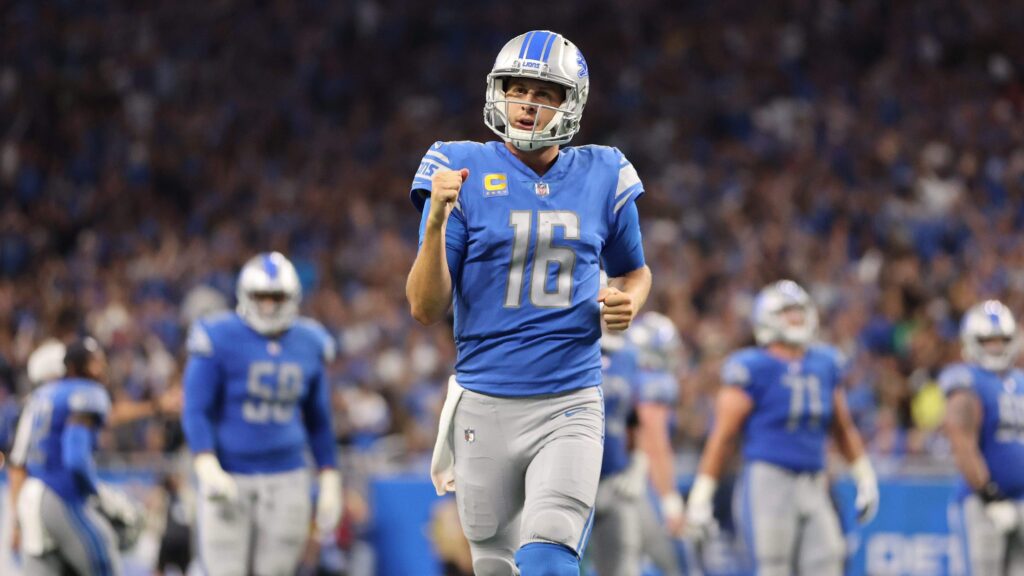
Having a franchise quarterback with a proven track record, like Jared Goff, is typically a better bet than more volatile options who haven’t definitively proven they’re “The Guy,” like Cam Ward, Tyler Shough, or C.J. Stroud. The NFL is desperate for quality quarterback play, and even Tom Brady has openly discussed the lack of development that organizations give their young talent at the position.
The running back position has a milk-like aging timeline. Many managers make the dynasty mistake of overvaluing the position. They have to be truly elite to sustain success and high value long-term. Players under 25 who have proven they are truly elite are Bijan Robinson, Jahmyr Gibbs, and arguably De’Von Achane. That’s it. Omarion Hampton, Ashton Jeanty, and Jeremiyah Love are all great-to-elite prospects, but I’d argue none of them have realized that projected valuation on the NFL field for fantasy.
Unless you have elite vets or prospects like these who consistently give you 17-plus points per game, you need to apply a standard three-year window to the running back position. There isn’t enough time to wait for a breakout based on the average lifespan of the position. After their age-27 season, their value drops like a rock, especially if they don’t get a significant second contract.
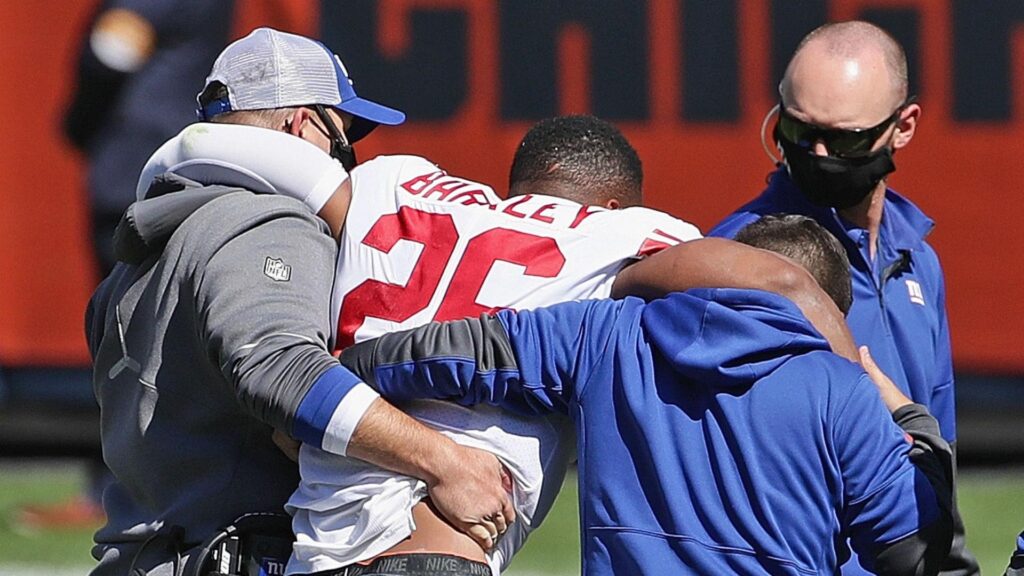
Injuries also crush even an elite running back’s value. Take an elite historical comp like Saquon Barkley. In early 2021, he was still being valued as a top-three dynasty running back, according to Dynasty Data Lab. This was after he tore his ACL the year prior. People believed in the talent and pedigree. They completely ignored the impact that an ACL tear has on the first year back for a running back, as well as the beating that comes with the running back position. Barkley couldn’t live up to those lofty expectations, and his valuation fell all the way down to fourth-round, RB13 overall the following year in dynasty startup ADP.
Wide receivers are the second-best aging asset. It’s not uncommon for them to remain relevant, even if they aren’t elite, into their 30s. Stefon Diggs just had a solid 2025 season, finishing as the WR17, just one year removed from an ACL injury for the New England Patriots at the age of 31. We’re seeing Davante Adams age like fine wine for fantasy, as he finished as the WR9 at the age of 32.
Meanwhile, look at what happens when great-to-elite running backs hit their 30s. Alvin Kamara looks completely washed, Nick Chubb just retired after fading into nothing, and Aaron Jones is a shell of his former self as well. Some may point to Derrick Henry, who, at 32, finished as the RB8. He’s the exception, not the rule.
Tight ends are the third-best aging asset. We’ve been spoiled as of late with several rookie tight ends breaking out within their first year, but that’s not the norm for the average player at the position. The transition from college to the NFL usually takes more time, so we typically see the peak around age 27. A dynasty mistake that I’ve seen most commonly is impatience for development at the position.
One of the worst instances that I’ve seen age out was someone in one of my leagues who let go of Trey McBride a couple of years ago, right before he broke out. You’re likely to see similar impatient moves from managers of either Kenyan Sadiq or Eli Stowers, who could easily do nothing during their rookie year but gain relevance by next year. You are better equipped to avoid these dynasty mistakes when you understand the age curves at each position, and when they each peak in value for fantasy production.
Dynasty Mistake #3: Impatience for Rookie Production
This dynasty mistake usually occurs with newer managers, not necessarily people who’ve played dynasty for a while. They get super excited during rookie season when every content creator is hyping up the potential of these prospects, so naturally expectations rise to the point where they’re expected to step onto the field and make an immediate impact.
I think a lot of novice dynasty managers give up too early on developmental players like Kenyan Sadiq and Eli Stowers because they don’t think they’ll break out right away. Preseason has already soured some newer dynasty managers on players like Carnell Tate, who have elite draft capital but have failed to shine outside of training camp.
This is where discounts can be had for the savvy manager, who doesn’t put much stock in vibes compared to analytical data. Growing pains are something I expect. At the same time, I do want to see progression as their rookie year goes on. I also find it necessary to consider outside influences, such as scheme, QB play, and injuries. It’s not necessarily fair to punish a player because his quarterback was completely inept.
It’s common to see some managers play dynasty and redraft the same way. I recently wrote an article discussing this dilemma called Dynasty Brain vs. Redraft Brain. Both redraft and dynasty fantasy football revolve around setting lineups each week, but they should not be played like the same game. At the end of the day, you still want to win the championship (just like redraft). However, you have to think about the long-term consequences of each move in dynasty.
Unless a rookie is truly elite, it’s relatively rare that they come in and just dominate the NFL in year one. They can take a couple of years to blossom into who they were projected to be when they were drafted. Jaxon Smith-Njigba was a rookie who was a slow burn initially, but turned out to be elite. As a rookie, he was buried on the depth chart behind both Tyler Lockett and D.K. Metcalf in 2023. His rookie production suffered as a result, and his value took a hit. Metcalf finally left, and that gave room for JSN to make a bigger impact than he had as a rookie.
At the start of 2025, he went as a top-15 dynasty WR in several of my dynasty startup drafts. I also saw him get traded away, as if he was going to be a bust at that cost. This was a dynasty mistake that I saw too many managers make. Now, he’s arguably the dynasty WR1 overall, and one of the most expensive assets to acquire on the open trade market.
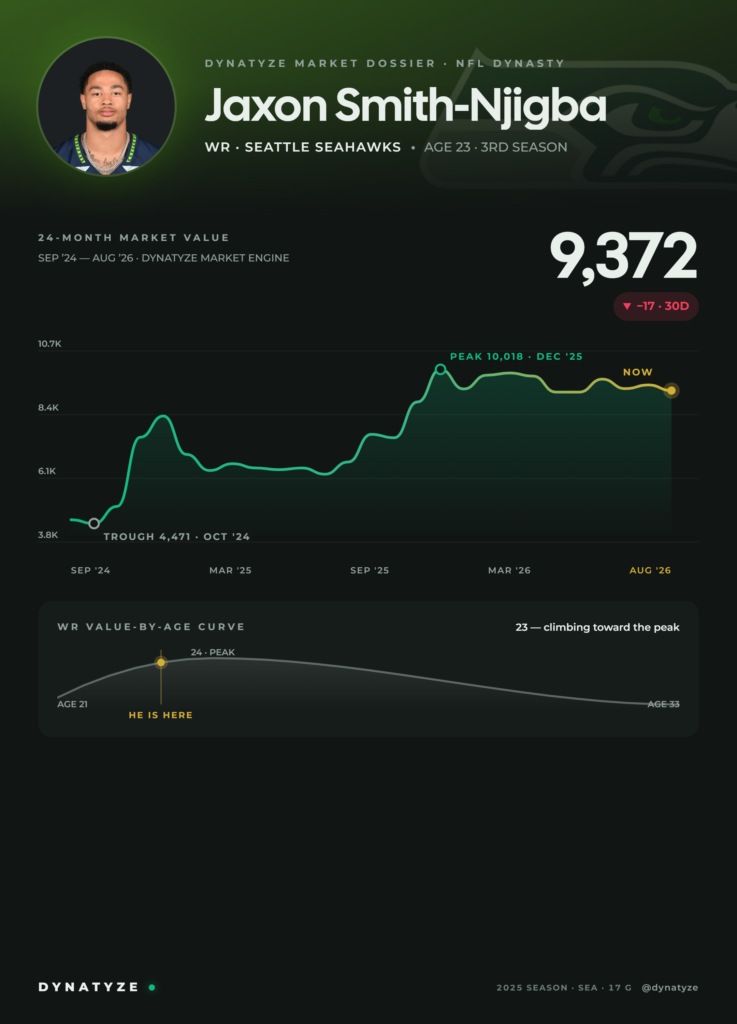
My player evaluation goes beyond just the box score for fantasy, as I look for efficiency metrics that are trending from average to good or good to great. Metrics like a rookie wide receiver seeing increased target share, a high yards-per-route run (YPRR), and a stellar route tree for creating separation. Luther Burden is a recent example: he finished with a 3.05 YPRR last year, and his role grew toward the end of the season. Team investment, like draft capital or contract size, is also important to consider because it determines the leash the player has to produce on the field.
Dynasty Mistake #4: Falling Too Hard for Unproven Hype
Both rookies and veteran players get outrageous hype during each training camp and preseason. These players can get steamed up in perceived value because of how well they’re doing in shorts. If your social media feed is anything like mine, it gets saturated with a slew of slow-motion videos posted by each team’s social media account to get their fans excited. This is how these videos get completely taken out of context, and people create false narratives out of them.
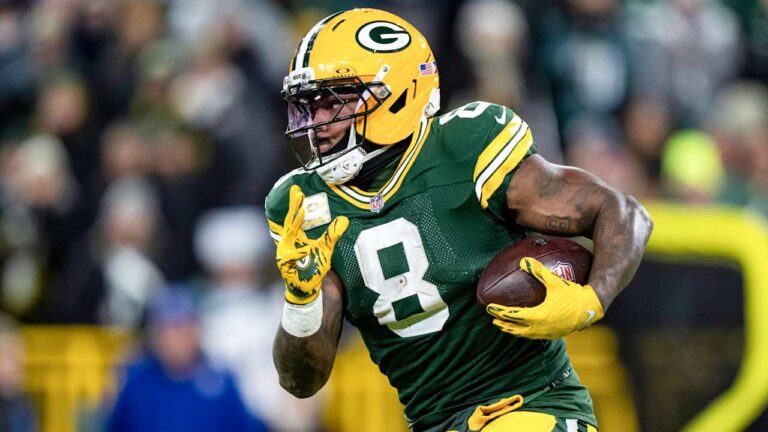
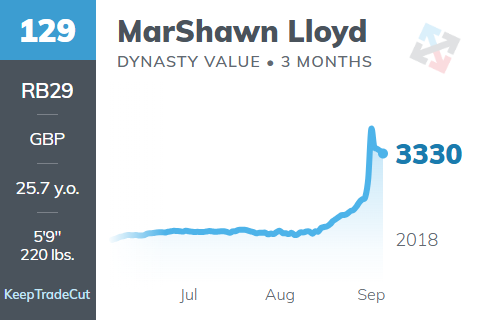
MarShawn Lloyd is the most recent example of this value spike based on hype. Josh Jacobs is facing legal troubles and, as a result, has been put on the commissioner’s exempt list. Lloyd seems healthy now, based on all the recent reports I’ve read, and has been getting first-team reps in Jacobs’ absence.
This has dynasty owners salivating at the potential of now having an extra plug-and-play running back coming from the depths of their roster benches, as the Jacobs news was a shocking development. They assume they’re safely getting RB2 production now, purely because they’re projecting the same workload that Jacobs would have had. The problem I have is that the value he’s been given is based on nothing but hope. There’s no NFL production or significant draft capital to lean into for long-term value.
MarShawn Lloyd wasn’t even a high-end prospect for me coming into the league. I saw him as an OK running back whose biggest traits were his ability to break tackles, as well as his good weight-to-speed ratio score. While I’m happy for the player to be able to finally be deemed healthy enough to contribute something on the NFL field, there are several reasons to be highly skeptical of the hype narrative being perpetuated in dynasty circles right now. I’ll push past the easy arguments like his injury history or the fact that there’s a non-zero chance that Jacobs plays this year.
He was drafted in the weak running back class of 2024. Worse yet, he went at the end of the third round. Some dynasty managers are falsely interpreting Day 2 draft capital hit rates because they aren’t digging deep enough. As a collective, Day 2 running backs have about a 50% hit rate. However, the drop-off from the second round to the third round is staggering. Only about 35% of running backs drafted in the third round produce RB2 seasons in points per game (PPG).
He was already an older prospect coming into the league as a 23-year-old at the start of the 2024 season. He’s currently just over 25, so by the time he’s signed his second contract, he’ll be almost 27 years old. Since he’s not even close to an elite-level back, he’ll be hitting that running back age cliff soon. Even with low milage, age does impact physiology and the body’s performance ability. This is something we want to avoid paying up for, as I discussed earlier. He’s a player who could easily be replaced in free agency or the draft next year if he fails to deliver on this opportunity.
He’s never proven that he can be a bell-cow back. Everyone is projecting Josh Jacobs-level results, but he’s not that kind of talent. Even in college, he never dominated the backfield completely. At South Carolina, he returned as a backup after tearing his ACL. Even in the next two years of his college career, he never had more than 115 rushing attempts in a single season. For reference, Saquon Barkley just had 280 attempts last year after setting his NFL career record of 345 attempts the year prior to that.
People all over social media have spun the narrative that he’s going to stay healthy for an entire season and dominate the workload in Green Bay, when he’s never proven to be even capable of anything near that, even in his college days. This has ballooned his perceived dynasty value from being a roster clogger to a tradable asset overnight. This is a prime sell-high opportunity because it’s good process to capitalize on selling an unproven player with weak team investment. Don’t make the novice dynasty mistake of holding onto a player only because of hopium. There needs to be actual data-backed substance for it to pan out outside of the occasional outlier.