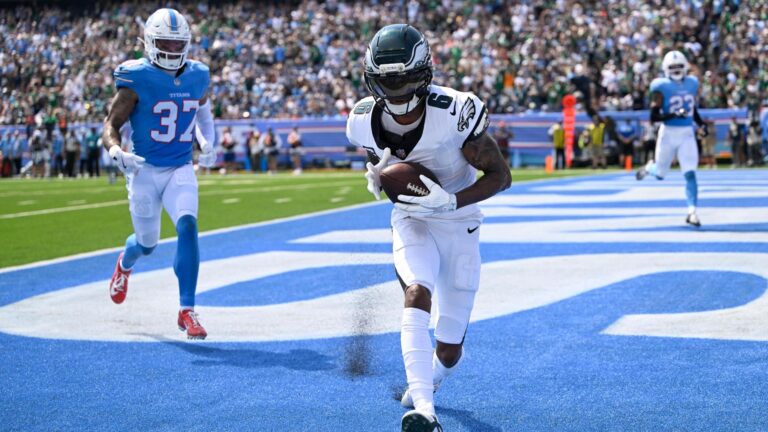
As the NFL offseason continues to unfold, it’s becoming quite clear that we’re witnessing a dramatic shift within the landscape of fantasy football drafts.
After wide receivers spent the last several years dominating the opening rounds of drafts, running backs are surging up boards in 2026.
Over on Underdog Fantasy, 17 ball carriers come off the board in the first three rounds, a meaningful shift from what we’ve seen in recent seasons.

The pivot is logical. Pass rates across the league are down, WR2 fantasy scoring plummeted in 2025, and league-wide rushing efficiency is up.
While it may be logical, we still have to be careful with the running backs we target, especially in the first two rounds of drafts.
Let’s take a closer look.
Introduction: The Idea of Legendary Upside
Pat Kerrane, a writer and podcaster in the fantasy football landscape, has spent the last five years championing the idea of “legendary upside” in regard to early-round running backs.
Given the lofty bust rate of early-round RBs, Kerrane believes that if drafters are going to spend their first (or second) pick on one, they need to target backs with profiles that feature legendary upside.
Kerrane’s definition of legendary upside is rigorous, but effectively, those RBs need to have a path to defining the fantasy season.
I wholeheartedly subscribe to this belief.
The high-end receivers are generally “safer” bets (lower bust rates), so if you’re going to take on the bust risk associated with early-round running backs, that player better come along with the ability to almost single-handedly carry your team to a championship.
This is all one big balancing act. Does the upside match the risk for a given running back? If not, taking the safer pick (a receiver, or even an elite TE) is likely the better move.
Looking at the 2026 season in particular, the rise of the running back is making it much more difficult to navigate drafts while embodying this mindset.
A Look at the 2026 Fantasy Football Draft Landscape
As ADP begins to take shape, one string of picks is particularly interesting: the 1.11 to the 2.06. Across this stretch, eight consecutive running backs come off the board.
Here’s a look at the current ADP:
- 1.11: Ashton Jeanty
- 1.12: James Cook
- 2.01: Saquon Barkley
- 2.02: Omarion Hampton
- 2.03: De’Von Achane
- 2.04: Kenneth Walker
- 2.05: Chase Brown
- 2.06: Derrick Henry
This range puts drafters in a rather tough spot; they’re effectively forced to take a running back (or two) in this range. Pulling up the likes of Brock Bowers, Drake London, and A.J. Brown would be justifiable. Still, almost every drafter from the 1.07 to the 1.12 is going to leave the first two rounds with at least one running back.
This means that these drafters are going to have to parse through the eight running back profiles and decide which ones are worthy of coming off the board at the 1-2 turn.
If you find the right one, it could very well prove to be a season-defining pick.
So, which of these running backs possesses legendary upside, and which are better off being left for your league mates?
Ashton Jeanty: The “Generational” Prospect With an Improved Environment
This run of picks gets going with a second-year running back who, after heading to Las Vegas with the 6th overall pick, was expected to help transform the Raiders’ offense alongside Brock Bowers.
Unfortunately, the Raiders’ dynamic duo couldn’t get anything going in 2025.
Throughout the year, Bowers was hampered by a knee injury he suffered in Week 1. Ashton Jeanty remained upright for 17 games, but the Raiders’ overall offensive environment proved to be too much to overcome; he finished as just the RB11, averaging 14.4 PPR points per game.
It’s difficult to overstate just how horrific Las Vegas’s offense was last year. 14.2 points per game, 245.2 yards per game, 4.4 yards per play, and -0.192 EPA per play all ranked 31st or 32nd in the league.
The offensive line, to Jeanty’s detriment, was also in shambles. His 1.28 yards before contact per attempt ranked 48th among 49 RBs with 100-plus carries. He was contacted at or behind the line of scrimmage on 25.6 percent of his carries!
Anecdotally, we also have the behind-closed-doors reports of Pete Carroll’s son, Brennan, the team’s offensive line coach, being a significant handicap.
“An agent of a Raiders offensive lineman said that his client told him the position group met multiple times on their own with Smith and Jeanty, and specifically without coaches, so the quarterback and running back could talk to them about how they wanted the offensive line to create blocks,” shared Kalyn Kahler and Ryan McFadden of ESPN.
“The agent also said his client said that Brennan Carroll rushed players through individual drills at practice and didn’t teach them what they were trying to achieve in specific drills,” they added.
Despite being set up to fail, Jeanty managed to post some encouraging peripheral metrics. His marks in missed tackles forced per attempt (0.17) and yards after contact per attempt (2.38) ranked 16th and 17th, respectively.
He also earned a meaningful role in the passing game, drawing a target on 22.0 percent of his routes, good for a 13.4-percent target share and 69 raw targets.
Jeanty proved that he is individually talented, and now, he’ll benefit from an overhauled offense, both on the field and on the sideline.
Enter Klint Kubiak, the mastermind behind offensive breakouts for both the Seattle Seahawks and New Orleans Saints over the last two years.
Last season, Kubiak’s Seahawks offense ranked 3rd in total carries and 27th in pass rate over expectation. With a rookie quarterback under center and a stud in the backfield, expect Kubiak to be as run-heavy as the week-to-week game script allows him.
In front of Jeanty and Fernando Mendoza, there will be a new-look offensive line that features a healthy Kolton Miller, a splashy free-agent acquisition in Tyler Linderbaum, and a young gun with upside in Jackson Powers-Johnson.
Jeanty has the three-down profile and explosive skill set to be a game-breaker in fantasy. All he needs is some semblance of offensive stability. Luckily, that seems to be coming.
Verdict: Target
James Cook: The Reigning Rushing Champ
Closing out the first round is Buffalo Bills running back James Cook, the NFL’s reigning rushing champ. After racking up 1,621 rushing yards and 14 total touchdowns, Cook finished as the RB6 in PPR leagues.
There’s no way around it; Cook was sensational on the ground last season. He was wildly efficient, averaging 5.25 yards per carry and 1.17 rushing yards over expectation per attempt, while going for 15-plus yards on 5.2 percent of his runs. He maintained that level of efficiency while handling 309 carries, the 3rd most in the league.
While Cook was incredibly impressive last season, it’s fair to question whether he features that season-defining upside.
In my eyes, we’ve seen ceiling outcomes from Cook in two consecutive seasons. In 2024, 18 touchdowns powered him to 16.7 PPR points per game. In 2025, 1,912 yards from scrimmage and 14 scores led to 17.8 PPG.
17-18 points per game is a very strong number, but it’s a far cry from the 20-plus PPG we get from the superstar running backs who power teams to fantasy championships.
Of course, some could make an argument that Cook could push his ceiling even higher, but I have a hard time seeing it.
Over the last two years, Cook has reached the top of the mountain on what’s possible from a volume, efficiency, and touchdown perspective.
The only box left to check, and the one that would allow him to eclipse 18 PPG, is elite receiving usage. But that’s not James Cook’s game.
He’s caught more than 40 balls just once in his four-year career, and generally speaking, he’s not a priority target in the Bills’ passing attack.
Last season, he ran just 217 routes (37.1-percent route participation), ranking 22nd among all running backs. His 40 total targets came in at 25th.
It’s difficult to envision this changing much. Joe Brady remains in place as the Bills’ playcaller, and Ty Johnson, the team’s preferred 3rd down back (played 70.5 percent of 3rd down snaps in 2025), is still on the roster.
Without much pass-catching work to buoy his floor, those who grab Cook at the 1-2 turn are hoping that he can turn in roughly 18 PPG on the back of high-end efficiency and a lofty touchdown total.
It’s a thin bet, especially with Josh Allen remaining a threat to siphon punch-in touchdown. Altogether, it’s a pick I’m not particularly interested in making.
Verdict: Fade
Saquon Barkley: A Confounding Profile
Saquon Barkley presents one of the toughest evaluations in this range.
On one hand, we all know that Barkley is capable of completely dominating the fantasy landscape over the course of a full season.
In 2024, his breakaway ability and the Philadelphia Eagles’ mauling offensive line turned Barkley into the definition of a league winner. His 355.3 PPR points were nearly 40 more than any other running back that season.
We’ve also seen Barkley function as a high-volume receiver. During his time in New York, he regularly surpassed 50 receptions per year. While we haven’t seen that in Philadelphia, we know the receiving chops are there. It’s a nice feather in the cap of Barkley’s proponents.
On the other hand, there are serious questions as to whether he can reach those 2024 levels of production in 2026.
Individually, Barkley is set to enter his age-29 season, meaning he’s around the age where many running backs start to hit a wall.
It’s a similar situation for the offensive line that played a key role in his dominant 2024 campaign. Lane Johnson is 36 and on the verge of retirement. Landon Dickerson is in the prime of his career, but nagging back injuries (along with ankle and knee issues) heavily impacted his play in 2025 and reportedly even had him considering retirement. Center Cam Jurgens was also recovering from a back injury last season, and, like Dickerson, didn’t play up to his standards last year.
Then, there is the whole host of questions surrounding the effectiveness of the offense as a whole. The QB-OC duo of Jalen Hurts and Kevin Patullo was disastrous.
The offensive woes most clearly manifested in the two games in which Philadelphia failed to complete a pass in the second half.
Drafters’ stance on Barkley will almost certainly be more driven by narratives than data. Do you believe that the Eagles can rebound in 2026 or not?
Personally, I’m buying the bounce back.
I do believe that injuries heavily impacted the play of the offensive line, in turn hampering Barkley’s ability to rip off the big runs that were a staple of his first season in Philadelphia.
The impact quite clearly shows up in the numbers.
Saquon Barkley 2024 Stats:
- 5.81 yards per carry
- 3.55 yards before contact per attempt
- 7.2% explosive rush rate
Saquon Barkley 2025 Stats:
- 4.07 yards per carry
- 2.11 yards before contact per attempt
- 4.6% explosive rush rate
While numerous factors played a role in this fall-off, the poor health of the offensive line was certainly towards (or at) the top of the list.
With all of the familiar faces back in the fold and a full offseason for each of them to recover, it would be no surprise if this unit returns to form.
Then, there’s the arrival of Sean Mannion, who’s taking the reins of the offense after the much-maligned Patullo was relieved of his duties.
Mannion does not have any history as a playcaller, so there’s no real data to reference, but it’s hard to deny that the vibes surrounding his new-look offense are high.
For starters, we have Jordan Mailata waxing poetic about what Mannion brings to the table: “Sean is an evil genius. That is my first impression. The guy knows ball. If I were to lock the three smartest people in the facility in one room, Sean would be there. And I think Sean would just be by himself. It would just be Sean. He’s a wizard.”
There have been rumblings of Mannion installing a Shanahan-esque zone-blocking run scheme, and the early returns are reportedly positive.
“An Eagles offensive line that brings back every starter looks healthy and has bought into the shift toward more wide zone blocking concepts under new offensive coordinator Sean Mannion,” wrote The Athletic’s Brooks Kubena.
“The health and confidence of what’s arguably been the team’s strongest and most tenured unit during its golden era is a good early sign that the Eagles could be headed toward a much-needed offensive resurgence,” Kubena also shared.
Earlier this month, Zach Berman, also from The Athletic, shared that Barkley has been getting involved as a pass catcher in Mannion’s offense and that it wouldn’t be a “stretch” to speculate that his role as a receiver could expand.
With A.J. Brown no longer in the picture, this would be a logical decision. Again, it’s well established that Barkley is a legitimate weapon as a receiver.
Whether it be an expanded role in the passing game or the return of the back-breaking runs that we saw in 2024, there seem to be multiple paths to recapturing the magic and production that allowed him to dominate fantasy leagues just two years ago.
Verdict: Target
Omarion Hampton: Mike McDaniel’s New Weapon
The story surrounding Omarion Hampton is quite similar to the one that’s being told about Ashton Jeanty. After underwhelming rookie seasons, drafters are optimistic that an improved environment will lift their fantasy production to new heights.
Hampton’s rookie campaign was disappointing for a variety of reasons. Most significantly, a fractured ankle cost him two months of the season.
Beyond the injury, when he was on the field, his production was rather volatile. Across nine outings, he turned in three top-12 weeks, but he failed to crack 8.2 PPR points in three separate games.
Hampton also ceded meaningful work to Kimani Vidal down the stretch, never hitting a 55-percent snap share in the three games in which both backs were healthy following Hampton’s return.
There are undoubtedly some negative aspects to what Hampton showed last season, but in reality, this was a redshirt year. He played in just five games before fracturing his ankle, which isn’t exactly a meaningful sample size.
With that in mind, it would be prudent for drafters to rely on Hampton’s prospect profile to evaluate what he might offer in year two.
In case you forgot, Hampton was a stone-cold killer at UNC. He was a full-blown workhorse in each of his final two seasons, eclipsing 280 touches and 1,700 yards from scrimmage in both years.
After wrapping up his time at UNC, he proceeded to post a 9.78 RAS, earn first-round draft capital, and grade out as a clear-cut RB1 in the esteemed Dwain McFarland’s Rookie Super Model.
Now, Hampton will take the field in his second NFL season with a healthy offensive line in front of him and Mike McDaniel calling the plays.
Many have crowned Matthew Stafford as fantasy football’s “wide receiver king-maker”. Stafford can hold that crown, but McDaniel is the running back king-maker.
During his time in Miami, McDaniel turned De’Von Achane and Raheem Mostert into fantasy superstars while consistently getting the most out of his rushing attack, despite often having numerous factors working against him.
His magnum opus came in 2023, when the Dolphins’ offense racked up 2,308 rushing yards and 27 rushing touchdowns, allowing Achane and Mostert to both average 17.8 PPR points per game.
McDaniel is also highly-regarded around the league for having an innovative, effective run scheme.
“Some of the stuff, in particular the run game, it’s next level. There’s no one else that does it quite like he does. He finds a way to find space to the inside and perimeter runs. He can gash teams that way. He is a little bit of that mad scientist,” said Chicago Bears head coach Ben Johnson.
All of the stars are aligning for Hampton’s fantasy outlook: individual talent, a premier offensive line and quarterback, and a king-maker running the show.
Look out for a massive Hampton breakout in 2026.
Verdict: Target
De’Von Achane: The Last Man Standing
This offseason, the Miami Dolphins parted ways with McDaniel, Tyreek Hill, Jaylen Waddle, and Tua Tagovailoa, leaving De’Von Achane as the last man standing from the offense that captivated NFL fans just a few years ago.
Achane is now joined by Malik Willis and a cast of forgettable pass catchers. Willis is capable of delivering some spike weeks thanks to his dynamic rushing ability, but for all intents and purposes, the Dolphins’ offense projects to be a one-man show.
Given the sentiment surrounding this offense, the fact that Achane is even drafted in the first 20 picks is a significant testament to his talent level.
Simply put, he’s an electric factory, both through the air and on the ground. Anytime the ball is in his hands, a house call is in the cards.
His explosivity (10.1-percent explosive run rate in 2025, 1st among 49 RBs with 100-plus carries) and heavy receiving usage (6.08 targets per game in 25 games with Tagovailoa since 2024) made him a truly elite fantasy asset.
That’s all set to change in 2026.
His speed isn’t going anywhere, but with McDaniel out of the picture and a lesser group of playmakers around him, all signs point to his efficiency taking a hit.
In the past, defenses have been forced to account for some combination of Achane, Hill, and Waddle, preventing opposing DCs from devoting too many resources to Achane.
The presence of two threatening receivers clearly worked in his favor. Last season, Achane faced stacked boxes (8 or more defenders) on 23.1 percent of his carries, which ranked 28th, per Next Gen Stats. In 2024, it was 20.2 percent, which came in at 22nd.
Now, Achane will essentially be the sole offensive threat, allowing opposing defenses to pack the box in an effort to shut him down.
His access to green zone touches (inside the 10-yard line) will likely crater as well. He’s scored a dozen touchdowns in each of the last two years. With the Dolphins expected to have one of the worst offenses in the NFL next year, hitting paydirt eight times would be a win.
The arrival of Willis could also prove to be detrimental. Beyond Willis vulturing touchdowns, his nature as a scrambler could put a significant dent in Achane’s receiving role.
According to PFF’s charting, Willis has scrambled 28 times across 209 career dropbacks, a scramble rate of 13.4 percent. For reference, Jayden Daniels has a career scramble rate of 12.7 percent.
Across 89 pass attempts with the Packers over the last two years, Willis has checked the ball down just three times for a checkdown rate of 3.4 percent. Tua’s checkdown rate has come in just below 10 percent in each of the last two seasons.
It’s a small sample, but it doesn’t paint a pretty picture for Achane. Sure, the designed targets will still be there. However, when receivers aren’t open downfield, Willis won’t be looking to dump the ball off; he’ll oftentimes be leaning on his legs.
Achane is a Ferrari chained to a fleet of Kias. He’ll inevitably lean on his horsepower to separate from the pack and explode for a few big games, but across a full season, I’m hesitant to spend high-end draft capital on a piece of what could be a historically bad offense.
Verdict: Fade
Kenneth Walker: Patrick Mahomes’ New Partner in Crime
After failing to reach at least the AFC Championship Game for the first time since 2017 (let that sink in for a moment), the Kansas City Chiefs went out and remedied one of their biggest offensive issues: a ground game with zero juice.
Kareem Hunt and Isiah Pacheco have kept the chains moving for the last few years, but that’s about all they’ve done.
Per SumerBrain, Chiefs running backs have recorded just two carries of 25-plus yards over the last two seasons.
Kenneth Walker will be tasked with flipping the script, and he has the skill set to do just that. During his time in Seattle, Walker’s elusiveness and tackle-breaking ability were often on display. In 2025, he averaged 0.28 missed tackles forced per attempt, the highest mark in the league among qualified rushers.
However, across his four years as a Seahawk, Walker failed to establish himself as a premier fantasy asset. That was largely driven by his limited workload, but either way, he topped out at 16.5 PPG.
Now, in Kansas City, Walker is positioned to put together a true breakout campaign.
Obviously, being the feature back in an offense led by Patrick Mahomes and Andy Reid comes with its own advantages. As long as he stays healthy, Walker should cruise to a career-high mark in the touchdown department (nine TDs is his current career best), and it would be no surprise if he makes a push for 15-plus scores.
Walker should also see the biggest workload of his career. In four years, Walker has never sniffed 300 touches, but that should change next season. The depth chart behind Walker — Emari Demercado, Emmett Johnson, Brashard Smith — presents little competition, giving him an opportunity to consolidate the backfield work.
Additionally, Reid and company certainly saw what Walker can add to an offense when he’s placed in a bellcow role. In three playoff games without Zach Charbonnet complementing him, Walker turned 74 touches into 417 yards from scrimmage and four scores.
While Reid won’t be planning to load him up with 25 touches per game, it’s safe to assume that he’ll want to get the most out of his $43 million RB, especially after watching Hunt fall down for 3.6 yards per carry for the last two years.
The most intriguing aspect of Walker’s move to Kansas City, though, is what the Chiefs’ offense can do for Walker’s carry-to-carry floor.
Walker has developed a reputation as a boom-bust runner and home run hitter. That’s not wrong; his success rate has consistently been quite poor, but he’s always capable of turning what should be a three-yard carry into a 25-yard chunk play.
In the Chiefs’ offense, that reputation could very well change. Kansas City’s offense is far better equipped than Seattle’s to help Walker avoid negative plays.
More specifically, over the last four years, the Chiefs have been far better at keeping their running backs from getting blown up in the backfield.
Here’s a look at the percentage of carries in which the ball carrier has been contacted at or behind the line of scrimmage:
Seattle Seahawks:
- 2025: 26.6%
- 2024: 27.2%
- 2023: 27.7%
- 2022: 25.2%
Kansas City Chiefs:
- 2025: 14.4%
- 2024: 19.6%
- 2023: 22.3%
- 2022: 18.0%
The above numbers are influenced by several factors, including offensive line talent and the threat that Mahomes poses as a passer, but they do illustrate that Walker is set up to be more consistent on a carry-to-carry basis.
So, we’re about to get one of the most explosive and elusive rushers of the 2020s in an offense that is going to feed him touches and is better suited to get the most out of his skill set.
Sign me up.
Verdict: Target
Chase Brown: Just Along For The Ride
Chase Brown offers a very interesting profile. He’s being drafted within the top half of the second round, but I’m not sure anyone out there is pounding the table for Brown as a legitimately talented running back.
In my eyes, he’s the least talented running back of this cluster… by a wide margin.
He doesn’t pop in the spreadsheets, and it’s the same story when watching him on the field. He’s a quality running back, sure. But he isn’t in the same realm as the Saquon Barkleys and James Cooks of the world.
Typically, being just an above-average running back would exclude them from possessing legendary upside. I think Brown is one of the few exceptions.
His role within a Joe Burrow-led Cincinnati Bengals offense is just so valuable. And with Cincinnati opting to run it back with the same stable of RBs in 2026, that role seems safe.
Let’s take a closer look at that role, starting with the basics.
Since being handed the keys to the backfield in Week 9 of the 2024 season, Brown is averaging 20.15 PPG in 16 games with Burrow on the field.
But if Brown isn’t an elite individual talent, how can he pile up fantasy points to that degree?
It’s actually pretty straightforward. When Burrow’s running the show, checkdowns and scoring opportunities are plentiful.
When the pocket collapses or receivers fail to get open, Burrow is more than willing to dump the ball off to his running back. His 13.5-percent checkdown rate led all quarterbacks (min. 100 attempts) last season, and since 2021, that number has never fallen below 8.2 percent.
Beyond Burrow’s tendencies, Brown is simply given plenty of opportunities to rack up receptions. His 54.2 percent route rate ranked 5th among all RBs last season, and his 374 total routes came in at No. 3.
When combining both of those factors, you get a receiving role that does plenty of heavy-lifting for Brown’s fantasy value.
In the 16-game sample that I previously referenced, Brown averaged 5.06 targets per game. For some context, Bijan Robinson came in at 5.76 targets per game last season.
Looking outside of that specific sample, in 2025 as a whole, when Cincinnati’s offense was also led by Jake Browning and Joe Flacco for significant stretches, Brown tallied 87 targets, the 4th most among all RBs.
On top of the pass-catching role, there’s the touchdown equity that comes along with being a member of the Bengals’ offense.
Once again looking at the same 16 games, Brown received 45 touches from inside the 10-yard line in those contests. Only one running back, Christian McCaffrey, had more than 40 such touches in 2025.
It’s difficult to even imagine Brown getting 45 inside-the-10 touches next season. Still, he could very well be among the league leaders in that category, propelling him to a towering touchdown number.
At the end of the day, Brown isn’t going to end the year as the Bengals’ offensive MVP. He can, however, hitch a ride with Burrow and company and end up putting together a league-winning season.
Verdict: Target
Derrick Henry: The Big Dog is Still Barking
For years, Derrick Henry has been among the most divisive players in fantasy football.
His doubters will point to his age and lack of receiving work. His backers will just show you his game logs.
To this point, he’s burned those who have faded him in devastating fashion. He’s now 32 years old, but the big dog is still barking.
The path to a legendary season for Henry is straightforward, albeit thin: rush for 1,800-plus yards and average roughly a touchdown per game.
He’s proven that he can do it, hitting at least one of those benchmarks in three of his last six healthy seasons.
The question is whether he can pull it off in 2026. I’m inclined to believe he can. Projections cannot contain this man.
When Henry and Lamar Jackson share the field, it’s magical. Lamar can heave haymakers and dice up defenses with his world-class speed and agility. The King can plow through all three levels of the defense on any given carry.
The magic was on full display in 2024. An MVP-caliber Jackson opened the door for Henry to be at his best, and Henry steamrolled right through it.
He toted the rock 325 times, averaging 5.91 yards per carry for a total of 1,921 yards on the ground. He had 19 carries of 20-plus yards. With the offense as a whole humming, he was also treated to 20 carries from inside the five-yard line.
Between Henry and Jackson, it was reminiscent of what Mahomes did in 2018, just on the ground instead of through the air.
With Jackson playing just four truly healthy games last year, I’m inclined to write it off as a lost year. Still, it wasn’t some horrific season out of Henry. He still barely fell below 1,600 yards and scored 16 times. A hobbled Jackson and a clunky offense prevented him from reaching his absolute ceiling.
Looking ahead, Jackson is healthy and raving about the new offense, and Henry has given us no reason to believe that he’ll be slowing down.
Expect Baltimore’s offense to find its stride once again in 2026, and in the process, Henry will receive the volume and scoring opportunities to produce a rushing stat line that leaves everyone else in the dust.
Verdict: Target