Navigating Tight End Premium scoring settings is the single biggest long-term edge in dynasty fantasy football, far outweighing the luck of finding a late-round breakout.
Too many managers treat 0.5 TEP and 1.0 TEP like slight variations of the same rule. That is a massive mistake. The math behind each scoring tier completely changes how you should value, draft, and trade tight ends.
Evaluating Tight End Premium: Wins Above Replacement (WAR)
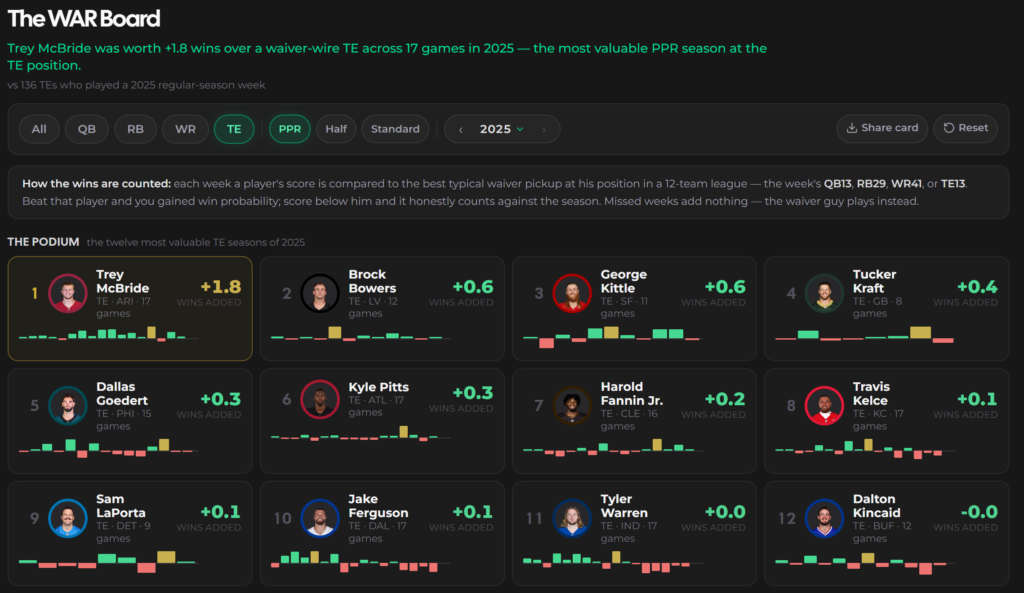
When evaluating tight ends, looking strictly at total fantasy points will lead you astray. The metric that actually dictates market value and roster construction is Wins Above Replacement (WAR).
- In 0.0 TEP: The tight end position yields the lowest WAR of any starting spot on your roster.
- In 1.0 TEP: Elite tight ends often post a higher WAR than top-tier quarterbacks in Superflex formats.
Adding premium scoring doesn’t just bump up weekly totals across the board. It alters positional liquidity, flex viability, and trade leverage.
Tier 1: 0.0 TEP (Standard PPR)

The Landscape: The “Onesie” Trap
In standard PPR formats, the gap between the TE1 and the TE12 is usually substantial (roughly 8 to 10 points per game). However, the gap between the TE6 and the TE16 is practically non-existent. Historically, only about two tight ends per season score enough points to be viable flex options over wide receivers.
The Strategy
- Startup Drafts: Either pay up for a true difference-maker in the early rounds or punt the position entirely until the end of the draft. Drafting a tight end in the middle rounds is a dead-weight investment because the output from TE8 to TE18 is statistical noise.
- Post-Draft Management: Mid-tier tight ends are nearly impossible to trade for real value. Do not clog your roster holding multiple average options hoping for a market spike.
Tier 2: 0.5 TEP (1.5 PPR for TEs)
The Landscape: The “Fake” Premium
Most managers assume adding a 0.5 PPR boost makes all tight ends inherently more valuable. In reality, this scoring tweak widens the gap between the elite tier and everyone else.
A pass-catcher with 100 receptions gains 50 extra points over the season, while a 40-reception tight end gains only 20 points. Instead of elevating the position as a whole, 0.5 TEP turns elite tight ends into high-end WR1s while leaving mid-tier options behind.
The Strategy
- Startup Drafts: Pay the tax for a superstar. The WAR advantage of a top-three tight end in 0.5 TEP is massive because they consistently outscore their positional rivals by 5+ points per game.
- Post-Draft Management: Volume is the only stat that matters here. Target share is everything, while TD-dependent secondary options remain un-tradable filler.
Tier 3: 0.75 TEP (1.75 PPR for TEs)
The Landscape: The Flex Tipping Point
This is the specific mathematical threshold where tight ends cross into regular flex territory. At 1.75 PPR, the TE6 through TE12 range consistently outscores the WR30 through WR40 range. A solid 70-catch, 700-yard tight end suddenly transforms into a dependable, high-floor flex starter.
The Strategy
- Startup Drafts: You have flexibility. You can wait on the position during drafts because the middle tier offers genuine starting utility.
- Post-Draft Management: Depth becomes a major asset. Injuries to your wide receivers can easily be covered by plugging in a quality second tight end. This format rewards balanced roster construction over top-heavy builds.
Tier 4: 1.0 TEP (2.0 PPR for TEs)
The Landscape: The Cheat Code
A full 1.0 premium completely reshapes league dynamics. Tight ends stop acting like a single-starter necessity and become the highest-scoring flex assets in fantasy football.
In 2.0 PPR, the overall TE1 can rival top quarterbacks and running backs in raw scoring output, while a fringe TE12 produces numbers comparable to a high-end WR2.
The Strategy
- Startup Drafts: Treat elite tight ends as premium first-round picks. Cornering the market on two top-eight tight ends gives you a structural scoring advantage that opponents rarely recover from.
- Post-Draft Management: Hoard target volume wherever you can find it. Even secondary tight ends on pass-heavy offenses become valuable trade chips to contenders needing high-floor flex production.
The Bottom Line: Tight End Premium Strategy Tiers
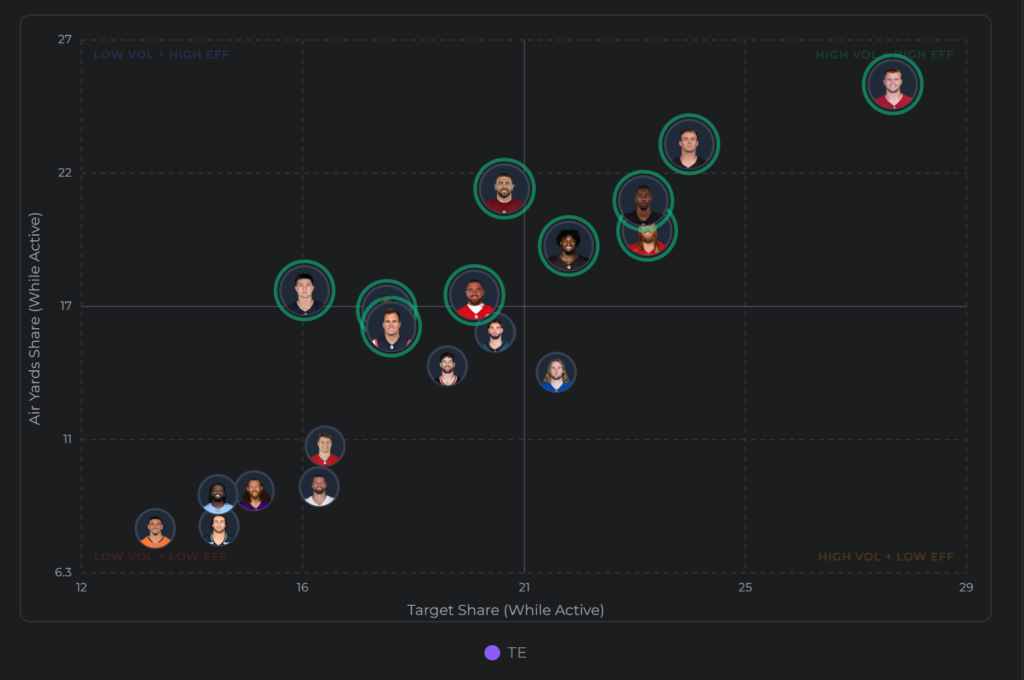
When navigating Tight End Premium formats, your strategy comes down to understanding where the flex threshold sits. In standard 0.0 TEP, the middle tier is statistical noise, so you should either invest early in a top-tier difference-maker or punt the position entirely. Moving to 0.5 TEP only widens that gap, making target hogs even more dominant while leaving average producers behind. The real tipping point happens at 0.75 TEP, where mid-tier tight ends finally cross into legitimate flex territory and reward roster depth. Once you hit 1.0 TEP, the position breaks wide open, turning tight ends into high-scoring flex assets that you should aggressively target early and hoard on your bench.