In both dynasty and redraft fantasy football leagues, building an elite roster is only half the battle. The wrong start/sit decisions can quickly turn a championship-caliber team into a losing one. Most fantasy football apps give you projections for each player, but it’s not always wise to follow them blindly. Oftentimes, if you do your own due diligence, you can make the right start/sit calls, especially when bye weeks and injuries come into play. Nothing is worse than seeing your ‘Max Points For’ tab rank among the best in the league, but your decisions led to a record that doesn’t reflect that.
Here’s the process to fix things moving forward:
5 Start/Sit Rules for Setting Your Fantasy Football Lineup
1. Role and Opportunity Share
This start/sit rule focuses mainly on running backs, wide receivers, and tight ends. Specifically, we want to look at targets per route run, snap share, and high-value touches. It’s great when a player runs a ton of routes, but if they aren’t earning targets, they’re just doing weekly cardio.
Snap share shows the player is actually on the field. Targets per route run shows whether their snaps are meaningful for fantasy production. If they aren’t logging snaps or getting targets on their routes, they aren’t scoring points.
High-value touches include receptions and red zone work inside the 10-yard line, or deep targets. These touches translate into higher point totals and touchdown equity, which creates ceiling opportunities.
Running backs who don’t catch passes are more dependent on touchdowns. Receivers and tight ends who get red-zone targets are more likely to have spike weeks.
Here’s what the numbers are saying for each line item:
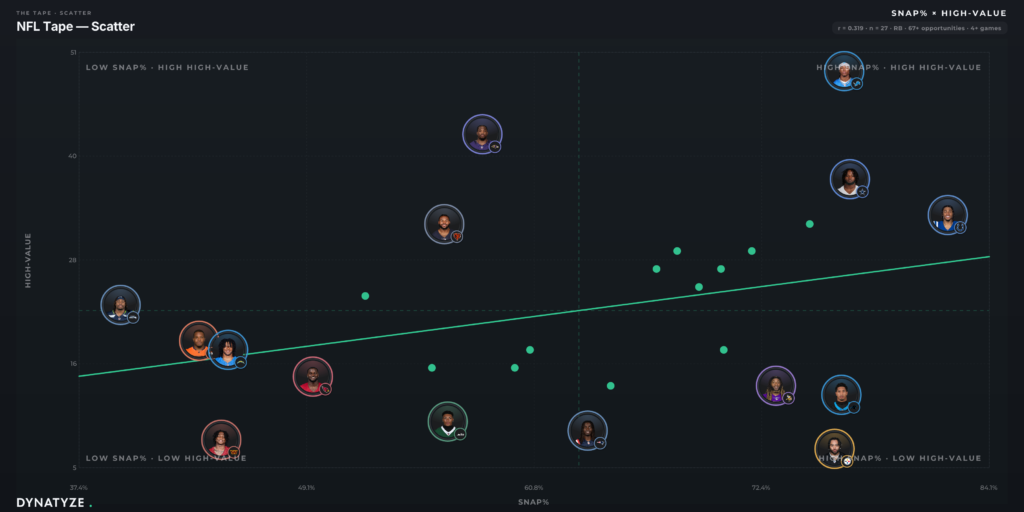
- Snap Share (Snap%) and Route Share (Route%): Running backs ideally want to be above the 45-65% committee threshold. If they are stuck in this range, they’re more likely to be flex options than they are locked-in starters. We want our receivers at 80%+ route% and 75% snap%, since anything under 70% route% is a part-time player who relies on efficiency to stay relevant in fantasy. For tight ends, we want 70-75% route%, with elites like Trey McBride (ARZ) and Brock Bowers (LV) pushing 80%+. Look at tight ends like Dalton Kincaid (BUF), who is efficient but isn’t getting enough snaps to be a reliable weekly option.
- Targets per Route Run (TPRR): Running backs want to be in the 15-20%+ range to raise their weekly floor and ceiling in PPR leagues. Receivers and tight ends who are hitting around 25% are reliable start/sit options.
- High-Value Touches (HVT): We want running backs to hit at least 4-5 per game, while receivers and tight ends who live in the red zone at 25%+ and have 2 or more deep targets per game are the difference-makers.
Below is an example Dynatyze chart for the running back position comparing snap% to HVT. The mantra “volume is king” is common sense, but volume paired with high-value touches separates the JAGs from the true difference-makers.
2. Player Props and Betting Market Signals
For this rule, we want to review the week’s spread and the team’s implied totals. What does Vegas say about this week’s matchup?
While a ton of data is available to the public, Vegas has far more resources to deep-dive into specific players. Using this information, we can compare players, see who has the more favorable matchup, who’s in a potential shootout, and who’s facing a positive or negative game script.
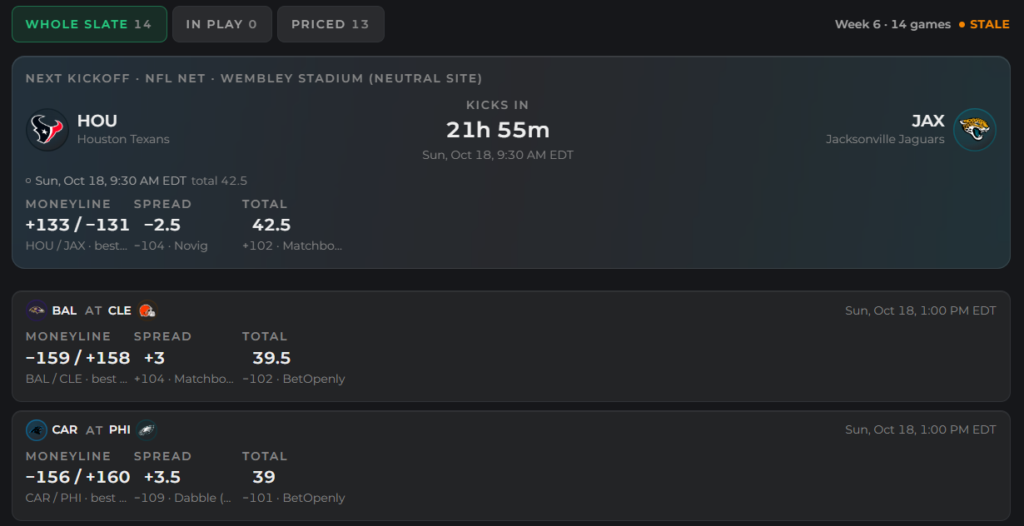
Relying solely on Vegas odds for start/sit decisions isn’t a strategy to use in a vacuum, but they’re a great reference point. A massive blowout favorite with a high team implied total often turns into a rushing clinic in the second half, limiting pass attempts. Conversely, when a bad team like the Arizona Cardinals is constantly playing from behind, they can generate elite PPR volume because they have to throw 40+ times to catch up.
If you’re torn between two players in or near the same tier, like a wide receiver in a negative game script and one in a positive game script, it makes sense to start the wide receiver in the negative game script, all else equal. Garbage-time pass volume can print fantasy points. Receivers in positive game scripts get phased out near the end of the game, as their team tries to kill the clock.
3. Upside vs. Floor
When playing weekly fantasy matchups, you can’t just rely on the projected points your fantasy app shows next to each player. You have to consider what your lineup needs: ceiling outcomes or floor points. This is especially true during bye weeks and injuries, when your lineup start/sit options are more limited.
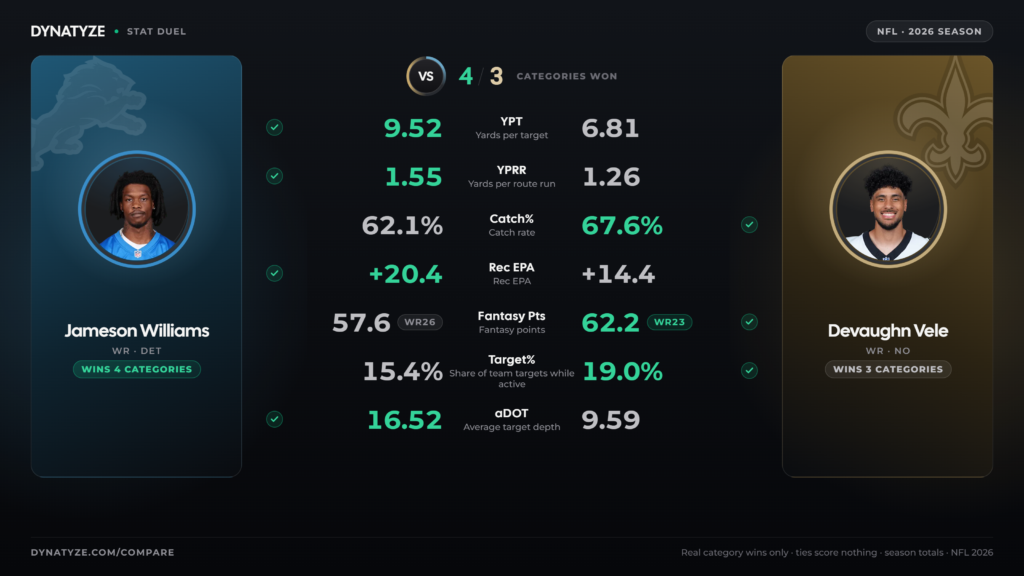
Look at the stat duel image below between two players with similar PPR points-per-game averages. Jameson Williams is the boom/bust ceiling play, as evidenced by his higher aDOT and Rec EPA. Meanwhile, Devaughn Vele is a nice, safe floor play, as evidenced by his higher target share and catch rate.
Let’s say it’s mid-season, and you’re facing an opponent projected to beat you by a significant margin. In this case, a floor play won’t help you actually win. You need a ceiling outcome. That is where we want to target more boom/bust options, or players with a higher ceiling overall.
On the other hand, let’s say this week’s matchup is projected to come down to the wire, or you’re projected to win comfortably. We want to avoid boom/bust options if we can, since a dud performance can wreck your odds for the week. Projections can help, but blindly following them for start/sit decisions without context can leave money on the table.
4. Scheme and Micro-Matchups
This is something that very few fantasy managers actually dig deep into, but it’s what a lot of start/sit articles use to help justify their takes.
Some players are good regardless of who covers them. However, when injuries pile up, a team’s WR2 filling in for the WR1 role could struggle to produce if a talented defensive back is shadowing them. You can gauge whether a team’s offensive scheme opens passing lanes by looking at play-action and motion rates, which can help you project outcomes in these receiver situations, since most NFL defenses rely on zone coverage.
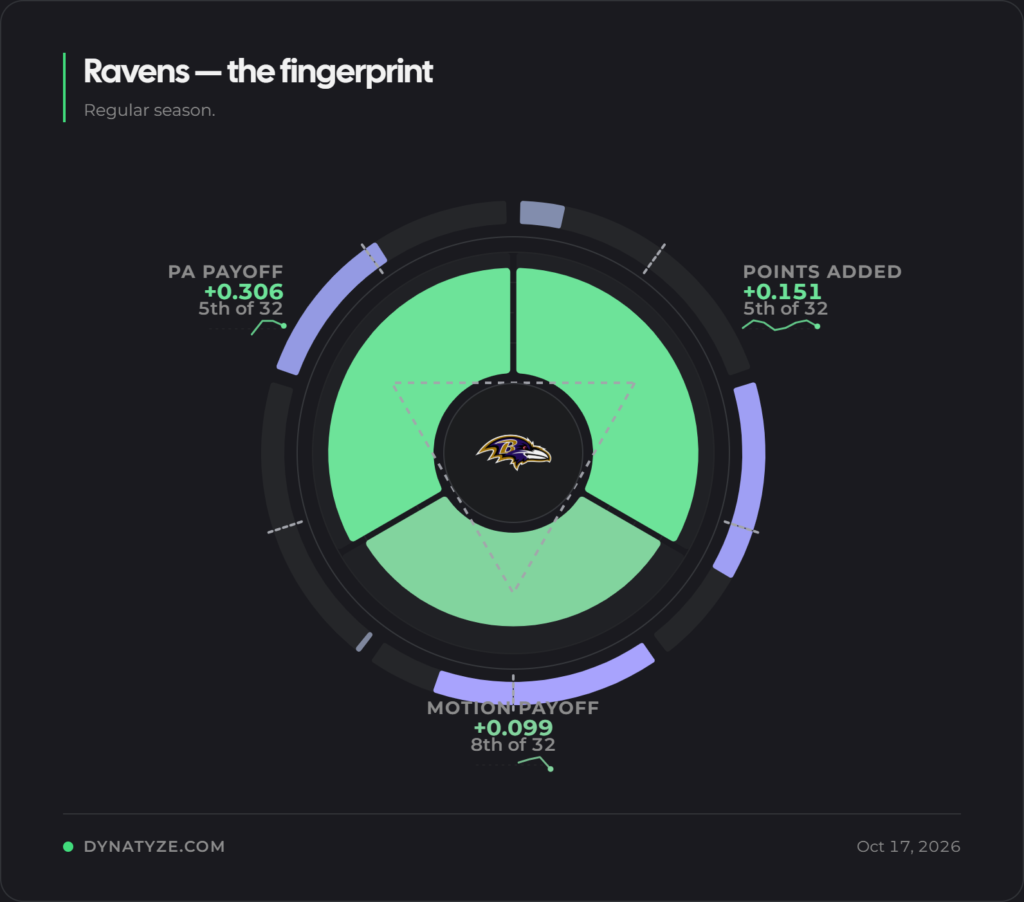
For instance, the Dynatyze offensive fingerprint below breaks down how Baltimore generates explosive plays through elite play action and pre-snap motion payoff.
When making a close start/sit call, look at the scheme. Does their offense lean pass-heavy, or does it focus on the run game? What personnel do they favor? Looking at pass rate over expected (PROE) can help you understand who’s more favorable in a neutral game script. If a scheme, like the Los Angeles Rams, relies on heavy personnel, you can project weaker outputs for their WR3, who won’t be on the field as much, and higher outputs for the tight ends, as they see a higher snap share.
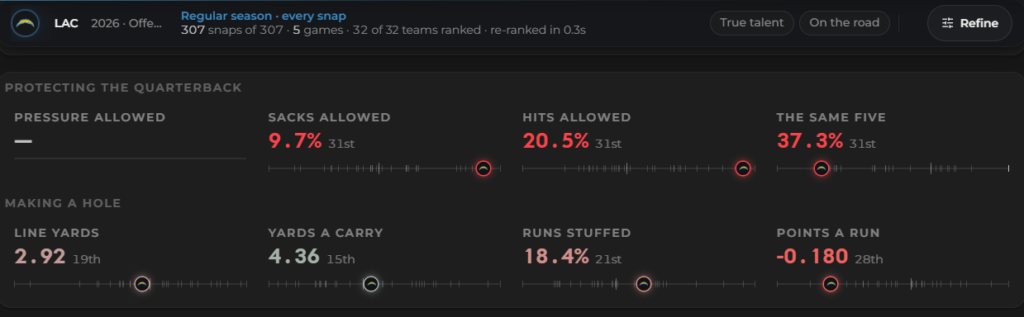
The average fantasy manager also under-values offensive line analysis. Offensive lines create holes for the running game and give the quarterbacks and receivers time to find holes in coverage. It’s wise to compare the pressure the opposing defensive line can generate with the offensive line’s blocking win rates. Because most running backs rely so heavily on their surroundings for fantasy success, noticing major changes on the offensive line can give you an edge in your start/sit decisions.
Just look at how bad the Los Angeles Chargers have been in the trenches. The entire offense is struggling right now and is impossible to trust. When an offensive line plays this poorly, you have to downgrade players who struggle to create out of structure against elite defensive fronts.
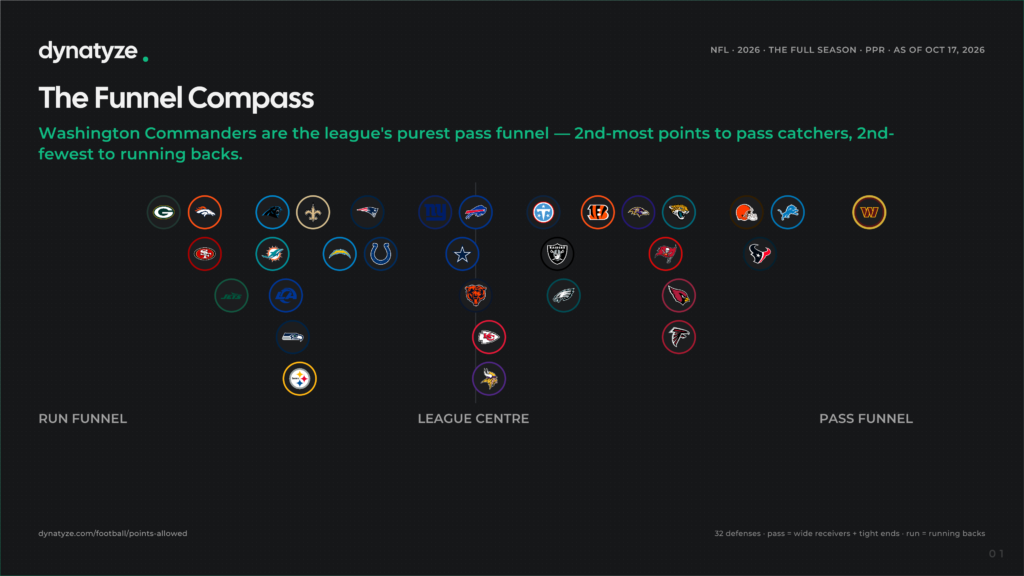
Another edge you can gain is by looking up how the opposing defense has performed against that position this year. While context like core defensive injuries can change how a defense functions throughout the year, it’s another comparable metric you can use when making start/sit decisions. When you have players in the same tier with similar situations and game scripts, it makes sense to favor the one facing a defense that has struggled more against his position.
The graphic below shows where defenses are currently weakest in 2026, heading into Week 6. Defense-versus-position is a great tiebreaker for players in the same weekly ranking tier.
5. The Environment
Before you make your final start/sit decisions, check which environmental factors will affect the game. Light rain, light wind, and light snow usually don’t matter, as many people overstate their impact. Focus on extreme conditions, such as winds of 20+ mph, below-freezing temperatures, and moderate-to-heavy rainfall. The passing game typically struggles in these conditions and often produces low-scoring games, which can have a massive effect on fantasy output. You typically don’t want to start players in these situations unless you have no other options.
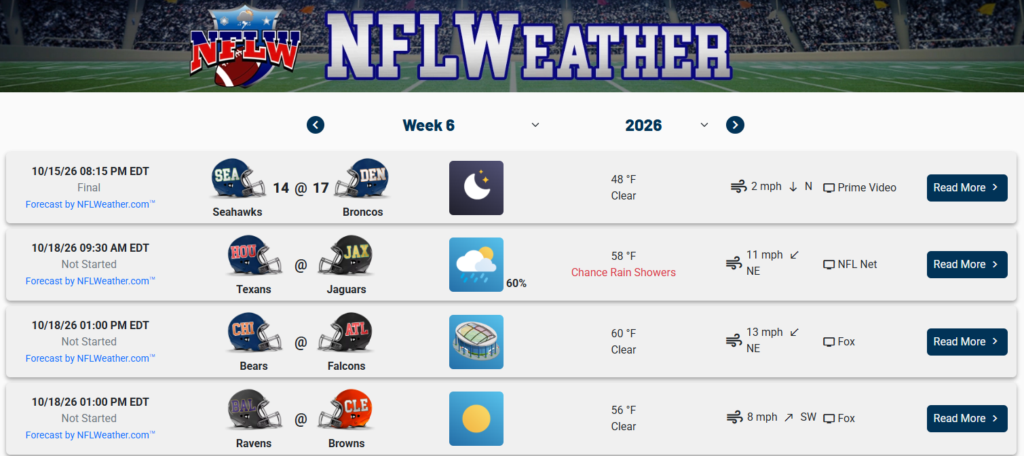
Meanwhile, players in domes have the best conditions because the environment is fully controlled. The NFL Weather website, as shown above, is an excellent source for information on every game on the slate, so you don’t have to look up each game individually.
Like this type of content? I post process-driven, actionable content like this regularly on X/Twitter (@TylerSutphenFF), so follow me there to stay up to date, and let’s win more championships!