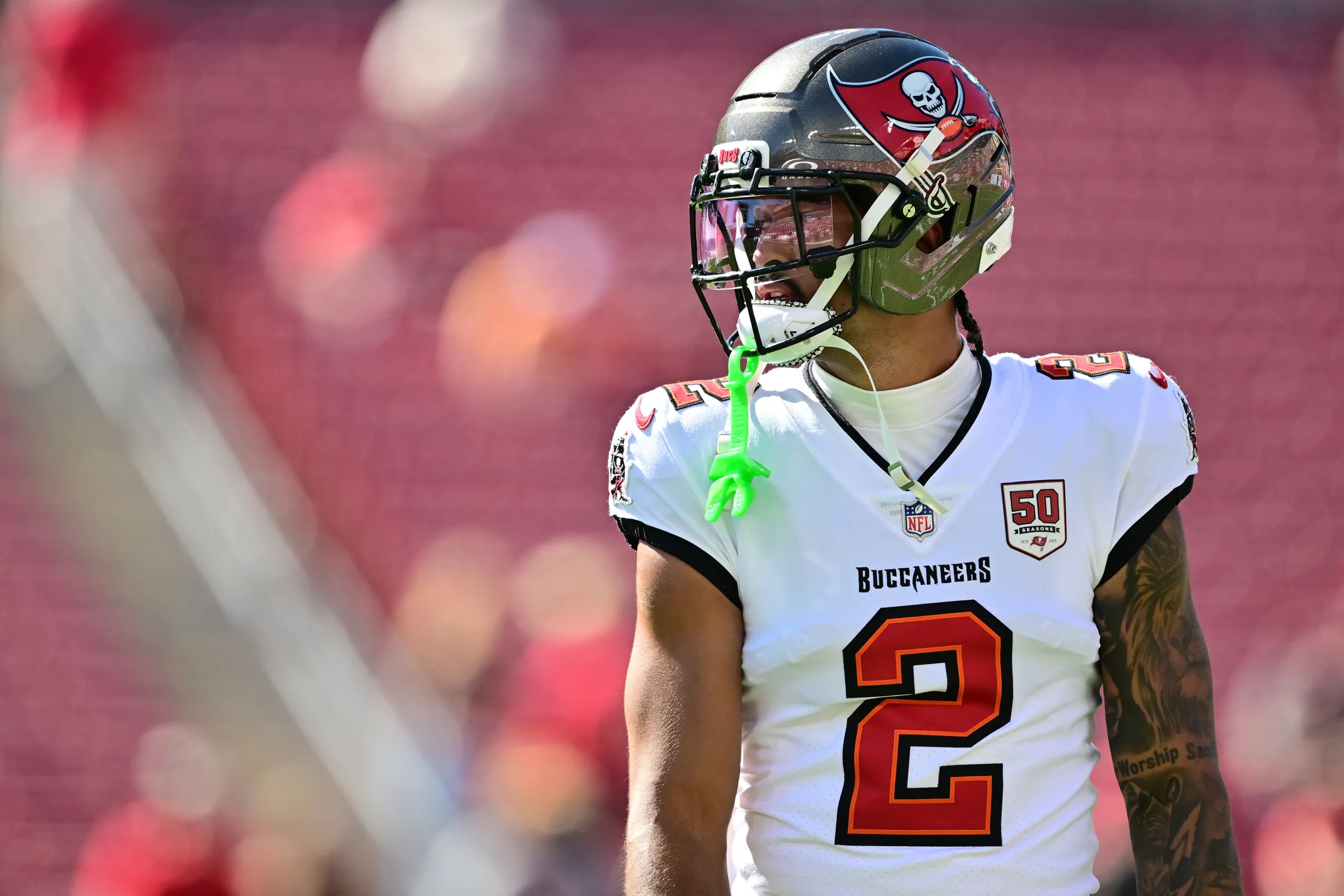
Ahead of the 2025 NFL season, Emeka Egbuka joined Garrett Wilson, Terry McLaurin, Chris Olave, Jaxon Smith-Njigba, and Marvin Harrison Jr. as a member of Ohio State’s wide receiver pipeline.
The Tampa Bay Buccaneers spent the 19th overall pick in last year’s draft to bring in Emeka Egbuka, setting the stage for him to play a key long-term role in the offense as Mike Evans and Chris Godwin entered the final years of their respective careers.
Egbuka’s arrival in Tampa Bay also had fantasy football drafters fired up. The Buccaneers were widely expected to have a fairly potent offense, so if he could carve out a role alongside the veterans, an impactful rookie season was certainly in the cards.
As we all know, his rookie campaign was a tale of two halves; it was an explosive start followed by a disappointing finish.
Now, as he prepares for his second NFL season, how should fantasy managers approach him in drafts?
WHAT TO MAKE OF EMEKA EGBUKA’S ROLLER COASTER ROOKIE SEASON
As soon as Egbuka set foot on an NFL field, he looked like he belonged. He posted a 4/67/2 stat line in his debut, good for 23.6 PPR points and a WR4 finish on the week.
He kept rolling from there.
Through Week 10, he posted some incredibly encouraging numbers:
- 16.3 PPR points per game
- 75.2 receiving yards per game
- 8.3 targets per game
- 24.0% target share
- 0.28 targets per route run
- 2.35 yards per route run
While he did have six touchdowns in those nine games, he was playing (earning) a role that was conducive to fantasy production. Per Fantasy Points’ expected fantasy points model, Egbuka came in at 15.4 XFP per game. Yes, a steady dose of downfield and end zone targets helped, but he wasn’t exactly sun-running; he was outperforming expectations by 0.9 PPG.
Along with the touchdowns, the intermittent absences of both Chris Godwin (played two games through Week 10) and Mike Evans (played four games through Week 10) during this stretch helped out Egbuka.
Still, he was drawing targets, and he was productive with those looks. It appeared that we had a full-blown rookie breakout on our hands.
From there, Egbuka’s production cratered. Here’s a look at the same numbers from Week 11 on:
- 6.1 PPR points per game
- 32.6 receiving yards per game
- 6.5 targets per game
- 21.1% target share
- 0.25 targets per route run
- 1.27 yards per route run
So, what happened? There were a few different factors at play.
First and foremost, as the receiving corps got healthy and Egbuka continued to struggle, his role was scaled back.
After running at least 80 percent of the routes in each game from Week 8 to Week 14, he failed to crack a 60-percent route share in any of his final four games.
Anecdotally, he also just wasn’t playing at his best. At times, he looked to be on a different page as Baker Mayfield, leading to near-miss plays and moments where they were out of sync.
Egbuka has acknowledged that he was worn down last year.
“I feel like I got my legs back a little bit. Last year, coming off the national championship and doing the whole rookie thing, the combine and everything like that, it’s definitely a long offseason and you feel like you never got a break,” said Egbuka during this year’s offseason program.
A hamstring injury he suffered in Week 6 could have played a role as well.
Either way, this all manifested in a decline in his playing time, efficiency and target-earning metrics, and overall production.
Getting back to the numbers, he struggled at the catch point in the back half of the year. From Weeks 1-10, his catch rate sat at 53.3 percent, and his drop rate came in at 4.0 percent. In the final stretch of the season, his catch rate fell to a paltry 44.2 percent, and his drop rate jumped to 9.6 percent.
Per PFF’s charting, he was thrown 19 contested targets in his first nine games, hauling in six of them for a catch rate of 31.6 percent. From Week 11 on, it was two receptions on eight contested targets, a catch rate of 25 percent.
His impact as a downfield playmaker also evaporated.
In the first “phase” of the year, he posted a stat line of 7/267/4 on 13 targets that came 20-plus yards downfield. In the second phase, the stat line was 2/60/0 on 10 such targets.
There were real struggles in the final weeks of the year, but not everything was necessarily on Egbuka.
In that first stretch, 63.9 percent of his targets were deemed catchable, per Fantasy Points. In the second, that number fell to 55.8 percent.
There’s only so much that he can do if passes aren’t in an area where he can make a play on the ball.
Okay, I’ve thrown a whole bunch of numbers at you, but what do I make of everything we saw last year?
Frankly, I’m not going to get all wound up about his late-season disappointment.
While they slipped, his target-earning and volume metrics remained solid, indicating that he was still a priority piece of the offense.
It was really the efficiency that took a significant hit, and as we know, that can be heavily impacted by variance and flukiness.
Drops, inaccurate targets, a lack of explosive plays. All of that can fluctuate heavily from week to week.
What Egbuka did show as a rookie is that he can earn consistent volume, make an impact in a variety of ways, and sustain high-end production across a meaningful stretch. Across the entire year, he drew a target on 26 percent of his routes, averaged 1.90 yards per route run, and posted 195.7 PPR points, all solid numbers for a rookie.
This is a player we should be excited about. But does that make him a worthwhile pick at his current ADP of 33.6?
EMEKA EGBUKA 2026 FANTASY OUTLOOK
There’s no doubt that a late-third-round ADP is a tough pill to swallow. After all, he finished the year as the per-game WR32, averaging 11.5 PPG. Now, he’s going alongside Tee Higgins, Ladd McConkey, Malik Nabers, and Garrett Wilson, all of whom have stronger track records and real upside.
Still, I’m very interested in making the Egbuka bet at this cost.
Of course, we have everything that we discussed above: Egbuka proved that he’s capable of being a high-level fantasy asset, and his late-season decline can (to some degree) be chalked up to variance and injuries to both he and Baker Mayfield.
But arguably the most exciting aspect of Egbuka’s year-two outlook is the fact that he’ll likely be playing a role that allows him to pile up targets.
“We’ll settle him into one spot, kind of our ‘Z’ spot, but again in some instances he might look like he’s playing the ‘X,’ in some instances he might be the ‘F’ just based on the formation and how you can move him around,” said Buccaneers offensive coordinator Zac Robinson.
“He’s very similar to a Cooper Kupp, just in terms of the way his brain works with the game of football and his natural instincts,” Robinson added.
Reception Perception’s Matt Harmon did a fantastic job explaining why this is huge for Egbuka’s outlook, highlighting how this role change (Egbuka often slotted in as the X receiver while Evans was injured last season) places him in a position to run a route tree that caters to his strengths.
The stage is set for Egbuka to potentially be a massive target earner.
A new role, an offensive coordinator who’s spoken incredibly highly of him, and a quarterback who’s proven capable of supporting elite fantasy production from receivers.
The only question is whether you believe he’s talented enough to capitalize on this opportunity to a significant enough degree.
Based on the ceiling we saw last season, I’m willing to make that bet — unlike The Wolf, who currently ranks him WR24 (-5 vs ECR). And in home leagues, where he will likely go later than what we see in best ball drafts (current ESPN ADP: 49.5), it’s one of the easiest clicks on the board.
Egbuka has already broken out. Don’t be surprised when he takes it to the next level in 2026.